
This Sunday, the lectionary invites us to ponder Romans 13:8-14. The English Standard Version supplies the heading, “Fulfilling the Law Through Love.”
Let’s say it’s Sunday in Kuala Lumpur. You’re leaving The Father’s House, after attending the morning service. You’re at the door, to leave the building. A man is standing there, as gatekeeper. He says only those who “name one ancient Christian whose name doesn’t appear in the Bible” can leave. He says there’s no right or wrong answer, but please give the best answer you can think of. Whose name will you give? Whose name would your two best friends give? Whose name would most people give?
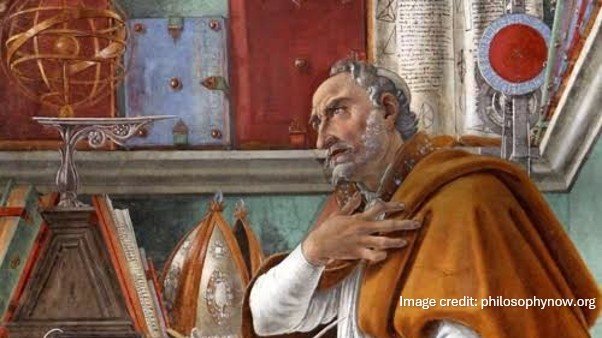
I would’ve given the name “Saint Augustine.” He was born in 354 AD. He’s famous for two books – which are still in print. One is called “Confessions.” The other is called “City of God.” “Confessions” is his autobiography. In it, he tells us what he believed and how he lived his life before his conversion. He tells us what sparked his conversion. He tells us how his life changed after conversion. He tells us that he lived out the beliefs and practices of a group called “Manicheans,” who followed the teachings of a man called Mani, who claimed to be in the chain of inspiring teachers including Gautama Buddha, Zoroaster and Jesus. Manichaeanism didn’t give him what he was looking for. He became very unhappy. He began to consider Christianity.
Depressed, sitting alone in the garden of a house, he became desperate. Became agitated, moved around the garden, beat things around him, pulled at his hair. Fell on his knees, shed tears. Cried out some words from Psalm 13, “How long, O Lord?” And then he heard the words, “take up and read,” sung by a child. And he remembered the name of a saint, who’d died when Augustine was only two years old. He remembered that in a moment of desperation, St Anthony had opened the Bible and begun reading. Remembered that what he read released him from dark despair into joyful freedom.
So, Augustine picked up a Bible. Opened it. A text jumped out of the page and entered his life. It’s part of today’s passage, from the Apostle Paul’s letter to Christians in Rome. It’s Romans 13:13-14. Listen to it:
13 Let us walk properly as in the daytime, not in orgies and drunkenness, not in sexual immorality and sensuality, not in quarrelling and jealousy. 14 But put on the Lord Jesus Christ, and make no provision for the flesh, to gratify its desires.”
Conversion means change, means choosing to live according to the insight that there is a God, and he’s not silent. In the Bible, through his instrument, the Apostle Paul, God tells us that we must value others, must show love towards them. Tells us that we’ll be constantly pulled to do things to satisfy our own selves more than others. Tells us[1] that therefore, we must resolve to live as people who owe a duty to love each other. Tells us that we must obey his commandments, summed up in the words,
“You shall love your neighbour as yourself.” 10 Love does no wrong to a neighbour; therefore, love is the fulfilling of the law.
Because Paul wrote those words immediately after he instructs us[2] to “submit to the authorities,” we must read the command “love your neighbour as yourself” politically. We must read them as including a command to ensure that those to whom we submit also obey God’s law of loving neighbours. We must read them as including a command to ensure fair access to health and wealth. Augustine discussed this in his second book, the full title of which is “The City of God Against the Pagans.”
Augustine was Bishop of Hippo in North Africa from 396-430 AD. In the early years of his service, he described the city of Rome as a flourishing “Christian city.” He said so in sermons he preached before Rome was invaded by “the Visigoths” in 410 AD. For example, in 404 AD, he said.
“Kings, lately, are coming to Rome. It’s terrific, …. It’s marvellous. Take note of it and see, rejoice.”[3]
Therefore, he was shocked when “Christian Rome” was conquered by non-Christians, pagans. He pondered it closely, to understand the hand of God in the world around him, in history. To help others understand, he wrote “The City of God.” In it, he argued for conversion as changing our citizenship from the city of man to the city of God; and working to make the city of man more like the city of God. [4]
How are Christians today exercising their citizenship of the City of God?
Peace be with you.
[1] In verse 8.
[2] In verses 1-7.
[3] I’m relying on Professor Bradley G Green, “Augustine’s The City of God and Why It Matters Today,” Christ Over All.
[4] But Augustine didn’t think in terms of modern social justice. He thought of earthly governments as damage control, to maintain a limited peace while awaiting the fulfilment of the Kingdom of God.

To learn more about Rama, click here.