
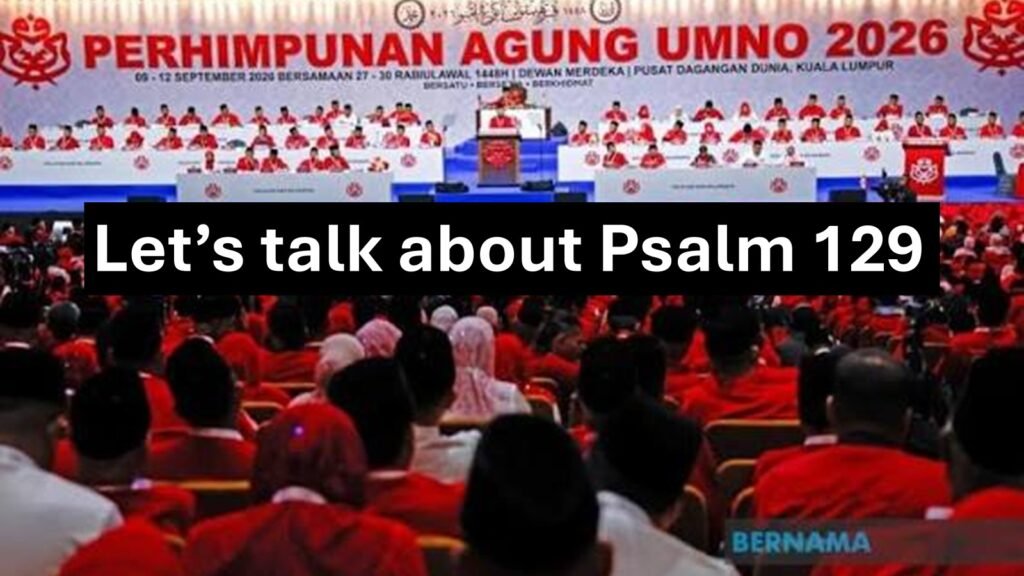
Why should we talk about Psalm 129? Well, because many are talking about it. Many are talking about it after Datuk Noorazli Said, a leading member of UMNO, Malaysia’s dominant Malay-Muslim party, mentioned it in a speech he made during the party’s General Assembly last week.
In his speech,[1] he told the story of a Catholic priest who suggestively touched the hip of a nun while driving her home. He said the nun responded, “Father, remember Psalm 129.” He said the priest responded by taking away his hand and uttering the Arabic word “𝐴𝑎𝑠𝑡𝑎𝑔ℎ𝑓𝑖𝑟𝑢𝑙𝑙𝑎ℎ,” which I take to mean, “I seek forgiveness from Allah.”
He said that when the priest got home, he rushed to his Bible and read Psalm 129. He said he found in the psalm a line, a text, which reads, “Go forth and seek further up and you will find glory.” I’ll not expand on what’s further up. I’ll leave you to imagine it.
Why did Noorazli choose to tell a story about sex? Did he suggest that priests view women as objects of pleasure? Did he suggest that nuns welcome men’s sexual interest in them? Did he suggest that the priest misunderstood the nun? Did he suggest that the Bible encourages sex outside of marriage?
Why did he use “holy characters” to tell a story about sex? Why did he choose a story which includes a religious text, a scripture. Why the Christian Bible? Why did he pick a Psalm? Why Psalm 129? Did he mock Catholics and Christians?
According to one news report,[2] Noorazli said he told the story in order “to highlight the importance of focus, perseverance and wisdom in achieving one’s goals.” The same report says he claimed he “never intended to insult, belittle or ridicule any individual, belief or religion.”
The Catholic Lawyers Society have lodged a police report about Noorazli’s speech. I’ve not seen the report, but I’ve read their statement, titled “Catholic Lawyers’ Society of Kuala Lumpur Condemns UMNO Leader’s Derogatory Remarks on Catholic Clergy, Consecrated Religious Life, and Scripture.”[3] It says Noorazli’s remarks “undermine the spirit of mutual respect and racial and religious harmony that the Rukun Negara was designed to uphold” and is contrary to the principle of the rule of law.
The Christian Federation of Malaysia also issued a statement.[4] It expressed “profound disappointment over the crude, erroneous and sacrilegious joke.” It said the priest-nun story was “an offensive example” and was “irresponsible and reckless.” It welcomed Noorazli’s “admission of error and apology,” and urged everyone to receive his words as “an important first step towards restoring respect and trust.” It also said,
“… we call upon the Government to ensure that the same principles and standards applied when individuals make insulting or offensive remarks concerning Islam are applied consistently when other religions and their adherents are similarly insulted or demeaned. All religions and their sacred beliefs should be accorded equal respect and protection under the law. Consistency in this regard is essential if we are to build a nation where all Malaysians are taught to respect one another’s faith and religious convictions.”
Many others, both Christians and non-Christians, spoke up. One Muslim pointed out the uproar and arrests there would’ve been if a non-Muslim had told the same story featuring an Ustaz, Ustazah and the Quran.
But let’s talk about Psalm 129. We may never know why Noorazli said Psalm 129. But he did. And it seems relevant. Because Psalm 129 is the scream of an oppressed people – like Malaysian Catholics whose internal weekly newspaper is barred from calling God “Allah”;[5] like Malaysian non-Muslims struggling to get planning permission for their buildings; like the Malaysian government hiding the truth about the abduction and disappearance of pastors and non-mainline Muslims.[6]
Psalm 129 is a ventilation of stress, to God, by an oppressed people. The English Standard Version supplies it with the heading, “They have afflicted me from my youth.” The Good News Bible supplies the heading, “A Prayer against Israel’s enemies.” Verses 1-3 say the backs of the people have deep marks on them because they’ve been “ploughed” by oppressors: think of the deep grooves left on the bodies of people who’ve been whipped or caned.[7] Verse 4 speaks of a vision. It says God – Allah in the 𝐴𝑎𝑠𝑡𝑎𝑔ℎ𝑓𝑖𝑟𝑢𝑙𝑙𝑎ℎ Noorazli put in the mouth of the priest – has cut off the ropes which pulled the plough over the backs of the victims. The remainder of the Psalm, verses 4-8, ask God to punish the plough-drivers, the oppressors.
How will churches and Christians respond to Noorazli? Well, they’ll appeal to God – as in Psalm 129 – and take actions to press for Noorazli to be investigated just like non-Muslims are investigated when their remarks allegedly “offend” Muslims: they’ll issue statements and make police reports. But they’ll not threaten Noorazli or his allies. Why? Because we’re in the resurrection era: the era whose ethics is not “eye for an eye” but “sawdust in your eye, plank in my eye.”[8] And if they’re wise, they’ll not offer Noorazli or Umno airtime or photo-ops to capitalize on any real or purported apology. They should press quietly for ending the use of sexual innuendos, upholding the constitutional right to freedom of belief, and ending the “liberty” leaders have to speak poorly of people of other faiths.
Let’s talk about Psalm 129.
[1] A Google search for a recording of the speech returned this baffling result: “Full unabridged recordings of Sepang UMNO chief Datuk Noorazli Said’s original speech have largely been restricted or taken down from public view following severe backlash and subsequent criminal investigations.”
[2] https://www.scoop.my/news/298422/sepang-umno-chief-makes-qualified-apology-over-clergy-joke-says-just-an-analogy/.
[3] I read it here: https://www.nabalunews.com/post/catholic-lawyers-condemn-umno-leader-s-remarks-call-for-retraction-apology-and-investigation?fbclid=IwY2xjawUZboJwZG9mBWV4dG4DYWVtAjExAGJyaWQRMVJXSDR0QUcwaWlYbEdEbkpzcnRjBmFwcF9pZBAyMjIwMzkxNzg4MjAwODkyAAEerjlSaJbvb2Vscls1qdiDqgS987S4snchvn2-9nMfkRU5maYVrXyKmpezGvw_aem_aLbJzmKHIsvZFfjmSRSs-A .
[4] At the time of my writing this column, it is not available on the CFM website, https://cfmsia.org/.
[5] Like Christians in Arab countries, in Indonesia, and the Bornean states.
[6] I’m thinking about Amri Che Mat, Raymond Koh, Joshua Hilyi and Ruth Sitepu.
[7] I’m relying on Walter Brueggemann’s interpretation.
[8] I’m drawing on the J B Phillips translation of Matthew 7:3-5.

To learn more about Rama, click here.