
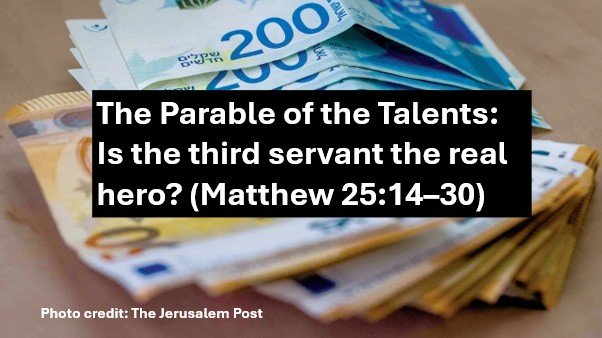
This Sunday, the lectionary invites us to ponder Matthew 25:14-30. The English Standard Version supplies the heading “The Parable of the Talents.”
The passage is in the last and final block of Jesus’ teachings in Matthew’s Gospel.[1] We call it the Olivet Discourse, because Jesus delivered it on the Mount of Olives. Matthew mentions the location because he wants us to recall the first block of teaching in his Gospel: The Sermon on the Mount, the collected ethical teachings of Jesus.
Matthew also wants us to recall Mount Sinai where, centuries earlier, God spoke to his people: when he told them how they should live as his chosen people, both as individuals and as neighbours; when he told them to give priority to the weightier matters of the law: recall what Jesus said in his last encounter with the scribes and Pharisees, in the Temple:[2]
“Woe to you, scribes and Pharisees, hypocrites! For you tithe mint and dill and cumin and have neglected the weightier matters of the law: justice and mercy and faithfulness. These you ought to have done, without neglecting the others.”
What does God say he will do to do to those who don’t give priority to justice, mercy, and faithfulness? That’s the question Matthew answers in block five, which is also called the eschatological discourse, the teaching about the end time. In it, Jesus tells us the end will begin with the total and absolute destruction of the grandest structure in the Middle East, the Temple in Jerusalem,[3] the focus of Jewish faith. The destruction of the Temple will mark the beginning of a time of great hardship for the disciples. Then, a day will come when the present age will end. The ending will begin with cosmic events. There will be utter darkness. Then,
“… [there] will appear in heaven the sign of the Son of Man, and then all the tribes of the earth will mourn, and they will see the Son of Man coming on the clouds of heaven with power and great glory.”
We’re not given a detailed roadmap. We’re just told that we’ll know when it happens. We’re told three things: One, the end will definitely come; two, we cannot predict when it will come, beyond saying “it could be today;” and three, we must invest our lives according to this knowledge. After we read block five in Matthew’s gospel, our hearts beat to the words, “am I investing my life according to God’s will?”
Matthew uses one of Jesus’ stories to introduce words we hope to hear from Jesus, on the day he returns:
“Well done, good and faithful servant.”
Today’s passage has four key characters: one master and three “bonded servants;” bonded, because they were denied the freedom to go and work for anyone else: like most foreign workers in Malaysia today.
The master sets off on a long journey. Before leaving, he gives money to the three servants. Huge sums of money – one “Talent” could pay 20-years daily wages for an unskilled labourer. The master gives 5 Talents, 2 Talents, and 1 Talent respectively to the first, second, and third of the servants. The amounts are different because he gives “to each according to his ability.” He goes away. Time passes. He returns. All the servants come to him. The first servant hands him ten Talents; the second hands him four Talents. They’ve doubled his money. To each of them the master says:
“Well done, good and faithful servant. You have been faithful over a little; I will set you over much. Enter into the joy of your master.”[4]
The third servant gives him back the same amount: one talent. Matthew explains,
“[The third servant said] ‘master, I knew you to be a hard man, reaping where you did not sow, and gathering where you scattered no seed, so I was afraid, and I went and hid your talent in the ground. Here you have what is yours.’ But his master answered him, ‘You wicked and slothful servant! You knew that I reap where I have not sown and gather where I scattered no seed? Then you ought to have invested my money with the bankers, and at my coming I should have received what was my own with interest. So, take the talent from him and give it to him who has the ten talents. For to everyone who has will more be given, and he will have an abundance. But from the one who has not, even what he has will be taken away. And cast the worthless servant into the outer darkness. In that place there will be weeping and gnashing of teeth.’”
What are we to make of that?
If “the master” is Jesus, would he have so severely punished a servant who returned all his money to him? A servant who kept the money in the safest way known to people at that time? A servant who “spoke the truth” to his master, saying he would not engage in making money by making loans to people who couldn’t afford to pay back the loans – then take their property and sell it for profit!
If “the master” is Jesus, would he approve of lending money at interest?[5] Surely not, since Deuteronomy 23:19-20 says,
“You shall not charge interest on loans to your brother, interest on money, interest on food, interest on anything that is lent for interest. You may charge a foreigner interest, but you may not charge your brother interest, that the Lord your God may bless you in all that you undertake in the land that you are entering to take possession of it.”
The Jesus we know from the scriptures and from our lives is gracious, forgiving, gives second chances. I think Jesus used the example of the master and the first two servants to commend good investment, investment in the things of his kingdom: justice, mercy, and faithfulness. I think Jesus used the dialogue between the third servant and the master to expose the wrong kind of investment which was the norm in Jesus’ day: profiting from the hardship of others. Jesus pointed out that those who exposed such wrongdoers should expect to be severely punished. This is exactly what happened to Jesus. In the following chapters we read that he was put out of the city and was crucified because he exposed the wrongdoers of his day!
I discussed today’s passage in a column I wrote three years ago under the title “Pak Bono says we misread the Parable of the Talents.” In that column, I invited readers to consider whether the story might be a veiled commentary on [Herod] Archelaus,[6] ethnarch of Samaria, Judea, and Idumea. Archelaus was the socio-political master of his day.
I wrote that the Indonesian theologian Pak Bono, drawing on the theologian Richard Horsley, discussed a similar parable of Jesus recorded in the Gospel of Luke, and said:
The parable says, “a noble man went to a distant country to get royal power for himself and then return.” Behind this parable was a historical event. The noble man was Archelaus, son of Herod the Great. He summoned ten of his slaves, and gave them ten minas, and said to them, “Do business with these until I come back.” (Luke 19:12-13). He did injustice business and wanted to exploit his slaves.
Jesus was not talking about developing mina or talents. His message was to resist exploitation and oppression. The hero was the slave who confronted the evil will of the king.
This interpretation is according to the context of the parable. Jesus was near Jerusalem (v. 11), approaching his crucifixion because he resisted all kinds of oppression by proclaiming the Kingdom of God.[7]
As I also pointed out in that column, Eusebius, bishop of Caesarea in the early 4th century, cited yet another account of Jesus telling a similar parable – and wrote that the real hero of the story “is the third slave who refused to cooperate in the investment schemes of the greedy master.”
Is the third servant the real hero? What do you think? Peace be with you.
[1] Block 5, chapters 24 & 25. For a list of the blocks, see endnote #8 in last week’s column, The ten virgins, mice, tigers, lambs, and wolves.
[2] Matthew 23:23.
[3] Matthew 24:1-2. The Romans destroyed the Temple in AD 70.
[4] Matthew 25:21, 23.
[5] I do not have the space here to discuss Christians views on interest. If you want to know more, check out Kevin Deyoung’s Is It Wrong to Charge Interest on a Loan?
[6] Herod Archelaus was brother of Herod Antipas, Tetrarch over Galilee and Perea. They were both sons of Herod the Great. See my column, Just How Bad was Herod the Great.
[7] As embedded in “The Nazareth Manifesto” which Jesus began his public ministry. See Luke 4:18-19.

To learn more about Rama, click here.