
This Sunday, the lectionary invites us to ponder Matthew 14:22-33. The English Standard Version supplies the heading “Jesus Walks on the Water.”
It happened just after Jesus fed 5,000 men and more who’d come to him in the wilderness. I’ve written about it before. I titled it “Was feeding of the 5,000 Jesus’ most political act?” We must consider the politics around the act because the attendance is reported according to the number of men present;[1] because the men wanted to make Jesus king and serve under him; and because Jesus urgently sent the men away.[2]
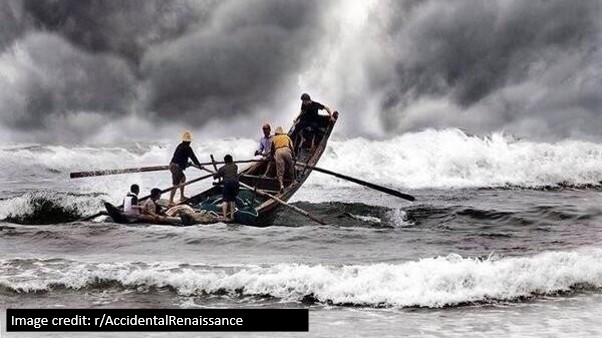
Jesus used his disciples, those who followed him on his journeys, to distribute the food he miraculously produced.[3] But he didn’t use his disciples to dismiss the people. No. He sent his disciples away – into a dark and stormy night, in a boat, on a lake known to be dangerous. And then he personally refused to enlist the men; and ordered them home.
Of course there’s more to it. Any reader who knows his Bible will recall the manna in the wilderness: the miraculous bread given for each day from heaven, through the intercession of Moses. Moses, whom God used to deliver the Israelites from oppression, and whom God used to give them the law and the Ark of the Covenant: the throne of the God of Justice and Mercy, in their midst.
I come now to the boat, the lake, and the walk. In our passage – which is paralleled in the Gospels according to Mark and John[4] – we read that between 3:00 and 6:00 AM, after several hours of rowing, of being tossed about by the storm, of not knowing what direction they were headed in, the disciples were exhausted and fear-filled. And they noticed a figure walking towards them. They thought it was a ghost. They were terrified.
Jesus immediately spoke to them, identified himself. Matthew and Mark report that Jesus said, “Take heart; it is I. Do not be afraid.” John omits “Take heart,” but includes the words, It is I; do not be afraid.”
Mark and John don’t include Peter walking on the water. Only Matthew includes it, Listen to verses 28-32:
And Peter answered him, “Lord, if it is you, command me to come to you on the water.” He said, “Come.” So, Peter got out of the boat and walked on the water and came to Jesus. But when he saw the wind, he was afraid, and beginning to sink he cried out, “Lord, save me.” Jesus immediately reached out his hand and took hold of him, saying to him, “O you of little faith, why did you doubt?” And when they got into the boat, the wind ceased.
Another difference between the Evangelists lies in how they end their accounts. Matthew ends with a positive account of the disciples. He says, “And those in the boat worshipped him, saying, “Truly you are the Son of God.” But Mark ends with a negative account of the disciples. He says, “they did not understand about the loaves, … their hearts were hardened.” John just says they were glad to take Jesus into the boat.
What are we to make of the fact that Mark and John didn’t report Peter’s water walk, and of Matthew and Mark’s vastly different assessments of the responses of the disciples?
We must remember that the Gospels were written by different authors, at different times, for different audiences, for different purposes. They used the incidents not only to tell the story of God’s plan for the world, carried out in Jesus. They also used the incidents to teach and to warn their readers. If you read different authors accounts of the disappearance of Malaysia Airlines flight MH370, you’ll find that each author emphasizes different things. The same reason explains the differences between Gospels.
Another thing we have to think about is Peter’s request. Why did he ask Jesus to call him to walk on the water and come to him? Was he just looking for a thrill? Or did he think it would be the best way to convince the other disciples that the figure was Jesus, just like he said he was?
Also, should we be critical of the others because they didn’t ask? And why did Jesus do what Peter requested? Was it because he knew Peter would fall, and it would be a “teaching moment” for a lesson on obedience, faith, doubt, and the dependability of God, who commands hearts and storms?
What do you think?
Peace be with you.
[1] The text, Matthew 14:21, mentions that women and children were also present.
[2] Matthew 14:13–21, Mark 6:32–44, Luke 9:10–17, and John 6:1–14.
[3] From a mere five loaves and two fish.
[4] Mark 6:45–52, and John 6:16–21.

To learn more about Rama, click here.