
This Sunday, the lectionary invites us to ponder John 14:1-14. The English Standard Version supplies the heading “I am the Way, the Truth, and the Life.”
The passage is part of a speech Jesus makes just before he submits to being crucified. It’s his farewell speech. He makes it after saying some shocking things to the twelve apostles about Peter and Judas. He shocked them by telling them Judas would betray him, and Peter would deny him.
After hearing his speech, they became agitated, anxious.
Our passage begins with Jesus responding to their anxiety. He says, “Let not your hearts be troubled.” He tells them that to get relief for their anxiety, they must believe he is God’s chosen instrument for their good.
He says they need to believe that his imminent death is a good thing. Good because it’s going to accomplish something. It’s going to accomplish the creating of abiding places, hiding places, for them. He puts it like this:
“In my Father’s house are many rooms. If it were not so, would I have told you that I go to prepare a place for you? And if I go and prepare a place for you, I will come again and will take you to myself, that where I am you may be also. … I am the way, and the truth, and the life. No one comes to the Father except through me.”
If you’ve attended Christian Sunday services or funeral services often, you’ll have heard sermons based on today’s passage. You’ll have heard preachers say “a place for you” is heaven, the place you will go to after death[1] if you’ve prayed “the sinner’s prayer.”
I believe there will be a day of judgment. I believe that all of us have failed to meet the standard of obedience which God demands. I believe that all of us deserve to be punished when we die. I also believe that all who “believe in Jesus” will not be punished.
The Bible says very little about heaven.[2] Yet, people say a lot about it. In a sermon, one of my pastors said he looks forward to going to heaven, because there he’d be always doing his favourite thing, which is wind-surfing. I wondered what his wife and children were thinking because he always surfed alone.
Fifty years ago, when I chose to follow Jesus, I didn’t know about heaven. I still think little about heaven. I think a lot about hell on earth. I think a lot about beggars on the streets of KL, and about murdered and murderous Africans, Americans, Arabs, Asians, and Israelis.
I think about Jesus’ words, “I am the way, and the truth, and the life.” I wonder what Jesus meant by those words. Why did he think that believing these words about him is the way to overcome anxiety? What did he think the disciples and others believed was the way, and the truth, and the life?
Why were the disciples anxious? They were anxious because they had left everything and followed Jesus for three years. They followed him because they expected to overthrow the Jewish and Roman leaders of the day, the oppressors. They expected to return their society to a state of wellbeing.
They may have had hell on their minds – hell for their adversaries. But there’s no reason to think they had heaven on their minds.
What they had in their minds was service. They wanted to continue Jesus’ work of feeding, healing, arguing, changing attitudes; to love their neighbours as Jesus had.
But Jesus told them that he was going to be arrested and killed; that they were going to deny him; that they were going to fall apart.
Jesus shattered their hopes. Because their hopes were built on wrong foundations. Built on their being channels of miraculous power.[3] Jesus told them their hopes had to be built instead on renewed hearts and minds. Hearts and minds which see Jesus less as teacher and more as master.
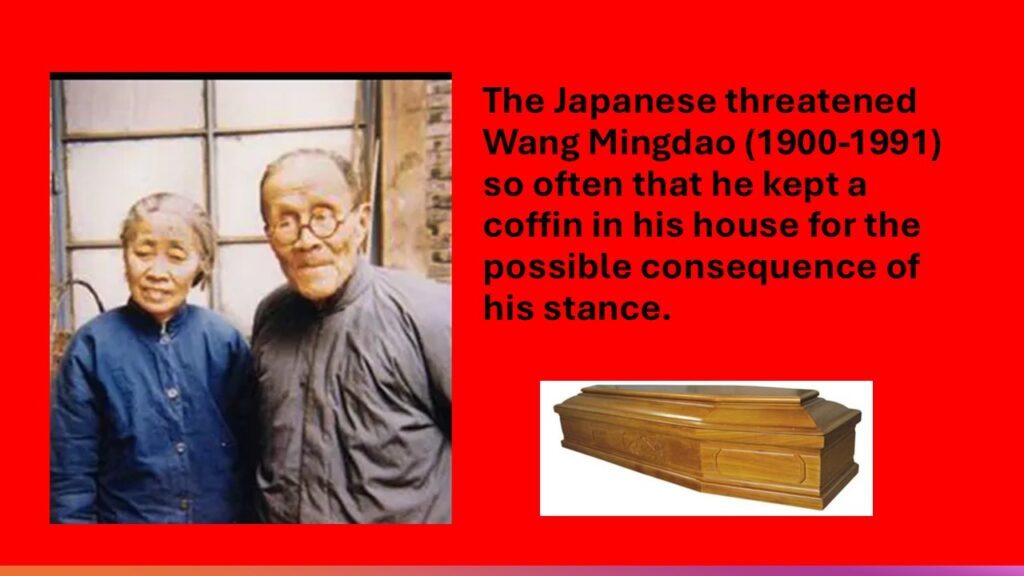
Today’s passage made me think of Wang Mingdao:
“Wang Mingdao (1900–1991) was an influential independent Chinese pastor and evangelist known for his fundamentalist theology and staunch refusal to align the church with the state. As a prominent leader in Beijing, he rejected the government-sanctioned Three-Self Patriotic Movement (TSPM), leading to his imprisonment for 22 years, becoming a symbol of the Chinese house church movement.”[4]
I read somewhere that once a student asked Wang, “What theology did you study?” and he responded, “Bitter toil theology.” That’s the answer of a man who spent 22 years in jail because he rejected safe, popular, understandings of “the way, and the truth, and the life.”
When I consider what I hear from pulpits, I worry that what preachers are promising is comfort, heaven, escape. I become anxious because I rarely hear about “the way, the truth, and the life.” I worry that I rarely hear about decay and decadence, about salt and sacrifice, about bitter toil.
If all we think about, if all we encourage others to think about, is comfort, heaven, and escape from this world, how can we be the salt of the earth? If we don’t constantly point out the injustices in our world, paint them as shameful, and position ourselves to overcome them, do we please God?
You can quickly learn much about Wang by reading the chapter about him in The [free, online] Biographical Dictionary of Chinese Christianity.
There are things in Wang’s life and thought which I dislike. But I admire his decision to keep a coffin for himself in his house.
How do we remind ourselves that “I am the way, the truth, and the life,” is a call to be ready to become victims of the leaders of the day?[5] Become their victims because we, with servant-hearts, work for and press them to practice, promote and establish compassion, equality, and justice.
Peace be with you.
[1] Commenting on today’s passage, missionary Bible scholar Lesslie Newbigin, wrote:
Religion has been fertile in producing words to suggest what may lie beyond that curtain—“heaven,” “eternal life,” “the next world”—but in truth we do not and cannot see what lies beyond (1982, page 178).
He also wrote:
The Father’s house, as we have already learned, is not a building made with hands. Nor is it another world beyond death. It is that new dwelling place of God in the Spirit which is constituted by the resurrection of Jesus from the dead (2:19-22; cf. Eph. 2:19-22). The death and resurrection of Jesus will inaugurate a new possibility—namely, that while we are still on the way, we shall have “‘a place” where we can already taste the joy of journey’s end, the joy of lovers’ meeting, the joy of being “with the Lord” (I Thess. 4:17) (1982, page 180).
[2] I’ve discussed this in previous columns. See for example, Why did Jesus eat the fish? Are there toilets in heaven?
[3] This should not be taken to mean that we do not have access to miraculous power. There are indeed times when we cast out spirits and give or receive miraculous healing. But this doesn’t detract from the fact that Christians established healing institutions.
[4]Google.
[5] The Lutheran Pastor, Dietrich Bonhoeffer, martyred by Hitler, famously said, “When Christ calls a man, he bids him come and die.”

To learn more about Rama, click here.