
This Sunday, the lectionary invites us to meditate on Matthew 11:16-19, and 25-30. The English Standard Version supplies the heading “Messengers from John the Baptist,” to verses 1-19, and the heading “Come to Me, and I Will Give You Rest,” to verses 25-30.
Jesus had just sent out the Twelve apostles. Sent them out after warning them to expect both suffering and hospitality. Sent them out to proclaim and demonstrate that the long-awaited Kingdom of God had begun.
That was in chapter 10.[1] So, we expect chapter 11 to begin with an account of the Twelve attending a debriefing session with Jesus. We expect accounts of healings and exorcisms, joy, and feasting. But Matthew doesn’t tell us about any debriefing.
Instead, he tells us that Jesus “went on to teach and preach in their cities.” Tells us that John, in prison, heard about what Jesus was doing. Tells us that John sent his own disciples to ask Jesus whether he was indeed the Christ,[2] the Messiah, the one promised by God in the scriptures.
Matthew doesn’t say why John doubted whether Jesus was the Christ. Probably, John was surprised at how different Jesus was from himself. John stayed put in the wilderness and kept away from population centres; Jesus travelled around the country and travelled into population centres. John ate simple food and avoided alcohol; Jesus ate meat and drank wine. John mostly scolded; Jesus mostly showed mercy.
Jesus told the messengers to tell John what he was doing. Jesus stressed that he restored sight to the blind. He stressed this because the prophets had said this would be one of the signs of the Messiah: none of the previous prophets ever restored sight. Jesus also pointed out that he healed lame people, and people with leprosy. And even restored dead people to life. Everyone knew that few of the prophets of old had performed healings, and even when they did, healings were rare.
Jesus lavished praise on John. Said John was the last of the prophets. The greatest. Ever. Then Jesus returned to his favourite subject. The subject of the Kingdom of God. The kingdom he was born to inaugurate. A kingdom inaugurated with healings, exorcisms, restorations of life. The Kingdom he included in the model prayer which he taught his disciples, the Lord’s Prayer, the most-repeated prayer in the history of the church. Jesus said John was born before the advent of the Kingdom of God, and anyone born in the Kingdom, born after Jesus, is more blessed than John.
All that talk about healings, exorcisms, and restorations, made Jesus stop. Stop and pivot. Pivot to the people around him, the people who saw the amazing events which accompanied the Kingdom’s inauguration and heard the proclamation of it. But didn’t recognize the king of the Kingdom.
Despite all that the people saw and heard, despite the striking similarities between what was happening, with what was predicted in the scriptures, most of them chose to be either spectators, or critics. They went to watch John because they wanted to see a prophet. They went to watch Jesus, because they wanted to see miracles and listen to his arguments and speeches as if he were an entertainer.
Jesus went ballistic. Not ballistic like he did when he overturned the moneychangers’ tables in the Temple. He went ballistic in the words he used to describe the response of the people. He said they were worse than the worst people described in the scriptures. He said they were worse than the people of Tyre and of Sidon, and of Sodom.[3]
The first text for today, verses 16-19, is the conclusion of Jesus’ ballistic speech. Jesus compared the people to children who refused to dance. Dance, either to joyful songs at weddings or sorrowful songs at funerals. Jesus summarized what they thought, and said to one another:
18 For John came neither eating nor drinking, and they say, ‘He has a demon.’ 19 The Son of Man came eating and drinking, and they say, ‘Look at him! A glutton and a drunkard, a friend of tax collectors and sinners!’
In the second text for today, verses 25-30, Jesus returns to the other things he so often spoke about. He spoke about the poor, the exhausted – the ones he freed from sickness and oppression. And he spoke about the cost of discipleship, of being his “co-workers” in the Kingdom – I’m using the term which the Apostle Paul uses in his first letter to the Corinthians.[4]
Jesus offered them rest. He didn’t offer them escape. He offered them rest, refreshment, and ways to live which would induce their oppressors to reduce their suffering. I’m thinking of what the modern scholar James C Scott calls “everyday forms of defiance,” things like give an insistent moneylender not only your raincoat, but also your underwear. And if a soldier asks you to carry a load for one mile[5], insist on carrying it for a second mile – therefore causing the soldier to break military law.[6]
Matthew tells us Jesus told the people he could grant favour with God, could grant them entrance into the Kingdom.[7] And then, said to them:
28 Come to me, all who labour and are heavy laden, and I will give you rest. 29 Take my yoke upon you, and learn from me, for I am gentle and lowly in heart, and you will find rest for your souls. 30 For my yoke is easy, and my burden is light.”
Jesus asked them to believe him. To believe that there was a purpose in their lives. A purpose defined not by themselves or their oppressors. A purpose defined by God, and himself, the king of the Kingdom. Jesus offered them liberation – not by assembling an army to overturn the oppressors, but by winning them over to Kingdom values and practices, by winning them over to allegiance to the true king: God in Christ.
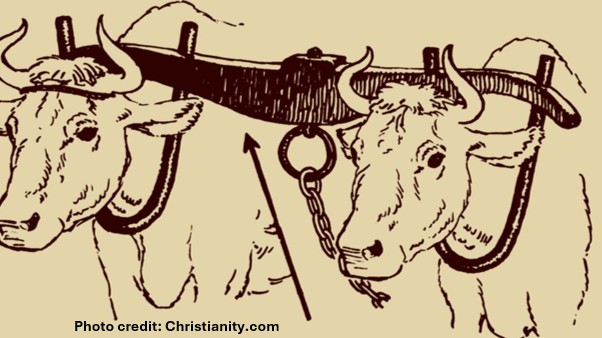
What is a “yoke”? A yoke is an object placed on the shoulder of an animal or a person. A yoke enables a person to pull a load, to accomplish some work, to fulfil a task. A yoke is a connection to others, and to God. A yoked person does work directed by another. A yoked person has a sense of personal and national destiny.
To whom are you yoked?
Peace be with you.
[1] See my column last week, https://bangsarlutheran.org/matthew-10-seriously-jesus-promised-us-the-reward-of-the-prophets/.
[2] See verse 2.
[3] Verses 20-24.
[4] 1 Corinthians 3:9.
[5] See Matthew 5:40-41.
[6] I’ve adopted the reading adopted by authors such as Richard Horsley and Walter Wink. Some commentators offer a different reading. For example, writing in TGC, George Sinclair says “Some people need to start to walk the second mile with divisive, angry, quarrelsome people in the hope that a conversation to know the truth will develop, and divisiveness will diminish.”
[7] Verse 27.

To learn more about Rama, click here.