
What’s your favourite quote about God? Right now, my favourite is C S Lewis speaking about God’s megaphone. He wrote,
“God whispers to us in our pleasures, speaks in our conscience, but shouts in our pain: it is His megaphone to rouse a deaf world.”
I’m thinking about God’s megaphone for many reasons. The haze has made my eyes itch, my throat tickle, my mood sink. Add to that the war in Gaza and abuses of presidential power in the USA. Add to that politicians sparring over who should lead in Negeri Sembilan and Najib’s pardon despite engaging in the crime of grand corruption.
About a month ago, I was told that some Christians were planning a seminar about corruption. I began thinking about what a preacher might say about corruption. I thought of Bible passages the preacher might appeal to. I thought about examples of corruption the preacher might bring up. I thought of actions participants might be encouraged to take.
I read articles and books. I listened to podcasts. I watched videos. I looked for frameworks we can use to think through the issue. I made a short video about the Zahid Hamidi case.
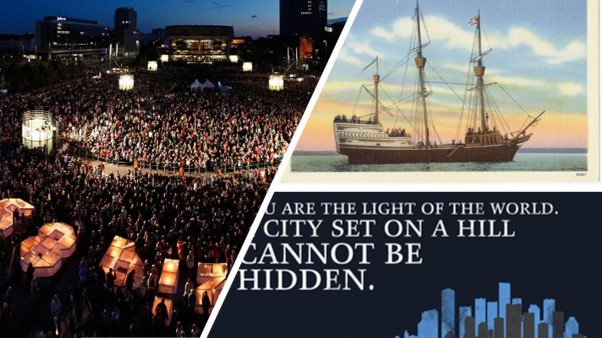
I remembered how, over the centuries, one Bible text has spurred Christians to shape the world. It’s in the Sermon on the Mount.[1] It reads,
“You are the light of the world. A city set on a hill cannot be hidden.”
I remembered a sermon John Winthrop preached in 1630,[2] on a ship called the Arbella, sailing from England to America. He titled his sermon “A model of Christian charity.” His text was Matthew 5:14. He explained that it was part of Jesus’ directions for building a community. He said they should adopt love as the essence of life together. He said that if they did so, their settlement would glow like a city on a hill, would attract people, would be the supreme model of how to live in community. Many see in his sermon the seed, the idea, the DNA, of the USA.
I also remembered the origins of the street protests in East Germany which led to the end of communist rule there and the reunification of Germany. It’s known as “the candlelight revolution.” You can read a good, short account of it online in Signs magazine. The title says it all: “The prayer meeting that toppled a regime: How a small group of faithful Christians instigated the end of Soviet-controlled East Germany.”
The author, Nathan Brown, begins with this sentence:
“One of the most remarkable revolutions of the 20th century began with a prayer meeting. In 1982, the Nikolaikirche—St Nicholas Church—in the centre of the East German city of Leipzig began hosting “Prayers for Peace” every Monday evening. Intercessions were offered both for a peaceful end to the Cold War and universal respect for human rights. Attendance was small for the first few years—usually no more than 10 or 12—and those who attended were monitored and occasionally harassed by the Stasi, the infamous East German secret police.”
He goes on to explain how they were inspired to pray by Matthew 5:14,“You are the light of the world. A city set on a hill cannot be hidden.” Their prayer led to organization, training, protest, change – the very things which impress me when I read about the civil rights movement in the USA which was led by the Baptist pastor, Martin Luther King Jr.[3]
Just like the American protesters led by King, the German protesters were nonviolent, though they encountered violence. Nathan Brown tells us,
“[The protesters] literally were a light in the darkness; but a person carrying a candle along a dark street is also an easy target … the candles … made it obvious that the protesters were unarmed. “To hold a candle, you need both hands—one to hold the candle, and the other to keep it from being blown out,” a protester explained. “You can’t hold a rock in your other hand.”
I come back now to God’s megaphone and the seminar.
The seminar was titled “Unity in Integrity, Governance, and Business Ethics.” The venue was Crossway Community Lutheran Church in Mont Kiara. The audience were mostly Christians: mainly laypeople, but also including about ten clergy. One of the speakers was Professor Edmund Terence Gomez. He spoke about corruption in Malaysia.
He pointed out that in Malaysia, billions of ringgit are lost to corruption every year. He showed us that we have a hard time naming corrupt actors in the private sector. He pointed out that the bulk of corruption occurs in public sector companies, which we know as GLCs, government-linked-companies. He provided a framework for understanding why corruption continues even when governments are replaced. He outlined steps we must take as a nation to end the epidemic of corruption.
I drove home thinking Professor Gomez models a long obedience in the same direction. He obeys the urge to make the world a better place for his neighbours, by shining light in dark places, by exposing corruption, by calling for reforms.
The following day, I attended Sunday service. The text was Matthew 5:14, “You are the light of the world. A city set on a hill cannot be hidden.”
I drove home thinking about the competition for corrupt wealth in Malaysia. Thinking about how so many others struggle to keep afloat. Thinking about C S Lewis writing about God’s “megaphone to rouse a deaf world.” I got out of my car thinking, “how deaf are we?”
Peace be with you.
[1] Matthew 5:14. The other text I thought of is The Lord’s Prayer, which teaches us to long for the coming of God’s kingdom. It’s also in the SoM: Matthew 6:9-13.
[2] His audience was made up of 102 people, counting both adults and children The stream of Christian faith they belonged to is called Puritanism. They came to be known as “The Pilgrims.” They sailed on many ships. The more famous of the ships is the Mayflower, which arrived in America 10 years before the Arbella.
[3] Famously, MLK wrote “Darkness cannot drive out darkness. Only light can do that. Hate cannot drive out hate, only love can do that.”

To learn more about Rama, click here.