
This Sunday, the lectionary invites us to ponder Matthew 9:35-10:8. The English Standard Version supplies the headings “The Harvest Is Plentiful, the Labourers Few,”[1] “The Twelve Apostles,”[2] and “Jesus Sends Out the Twelve Apostles.”[3]
Today, we read that after Jesus performed a massive number of healings – beyond what I discussed in last week’s column – he told his twelve disciples, his associates-in-training, that “the fields are ripe unto harvest,” and that they should ask “the Lord of the harvest” to send out labourers to bring in the harvest.
Today, we also read that Jesus sent out the Twelve to do the things he was doing: proclaiming that the kingdom of God had come, casting out unclean spirits and healing every disease and every affliction. Matthew includes the names of the Twelve, and stresses that Jesus instructed them to focus on Jews and actively avoid non-Jews.
While reading, many questions popped into my head. Why go to the people, instead of them coming to Jesus? Why choose twelve[4] disciples, instead of, say seven or ten[5]? Why limit the proclamation of the kingdom, and the healing and freeing, to Jews only? Why frame the sending in such a way that it could mean it’s limited to the Twelve only?
Jesus’ wanted the disciples, now called “the twelve apostles,”[6] to tell the Israelites, the Jews, about him. To show them that he wasn’t like anyone they’d ever met or heard of. To show them that Jesus was a channel of healing, of liberation, of government. To give them a taste of the new creation: where there will be no pain, no quarrels, no injustice, because all will be satisfied, and will care as much about others as about themselves.[7]
I think that explains why Jesus restricted the mission to Jews only: Jesus expected Jews to be the first members of the early churches. Because they knew the scriptures which spoke about him. They knew God had called them to establish a kingdom of righteousness on earth. They knew they had failed. Jesus expected that after he died and rose again, and the Temple was destroyed, they would see that he had fulfilled the scriptures.
But I think Jesus didn’t tell the Twelve to say all that. Because the people, and the Twelve themselves, weren’t ready for such a different interpretation of the scriptures from what they were used to. Their eyes would be opened only after he died and rose again.
So, what did he tell them to say? What training aids did he use to teach them? What training aids did he send them out with? I think “only” talking points about a new kingdom under a new king; and power to do healings and exorcisms[8] – to get attention.
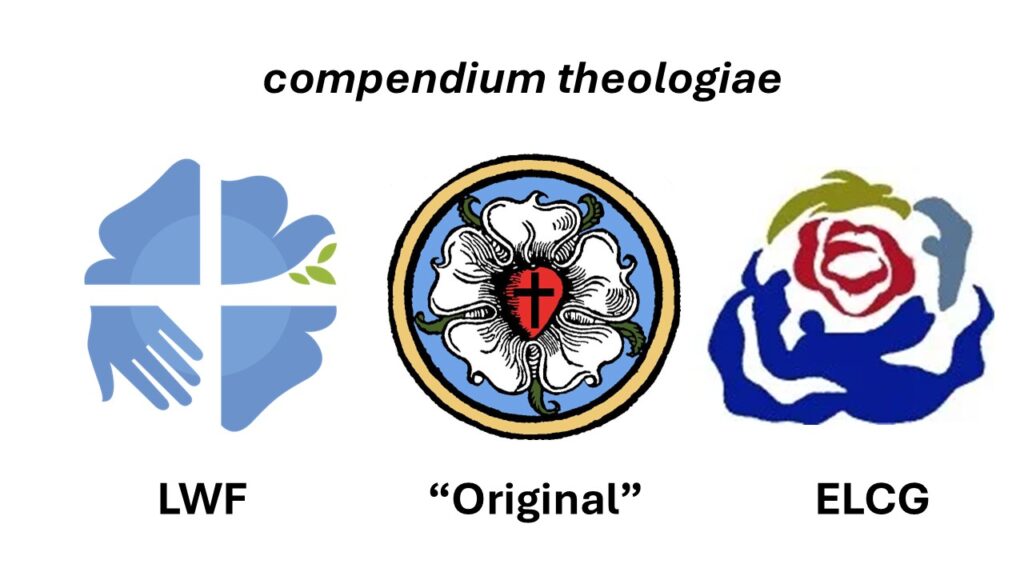
Which brings me to Luther’s Rose, his insignia. It was produced for Luther in 1530 by a creator commissioned by his king[9], Elector Frederick. Luther “accepted” it and “explained” it – partly because it would’ve been rude to reject it. He called it a compendium theologiae,[10] a summary of core Christian beliefs. He explained the five parts of it in a letter he wrote to his friend, Lazarus Spengler. He said:
The black cross shows that we’re saved through faith in the crucified Christ, and a battle between saint and sinner rages within each of us[11].
The red heart shows that the cross doesn’t kill us; it keeps us alive.
The white rose shows that faith gives joy, comfort, and peace. It’s white because white is the colour of spirits and angels.
The sky-blue background shows that our faith is the beginning of heavenly joy, and we’re surrounded by hope.
The golden ring shows that our heavenly blessedness is precious beyond all joys; and all goods; and lasts forever without end.
As I said in a sermon last month, my all-time favourite saying is a phrase framed by George Box[12]: “All models are wrong. Some are useful.”
I think Luther’s Rose is useful as a summary of Christian doctrine. But I think we must ask what’s left out, and whether what’s left out results in harm to our proclamation and witness to the gospel, the good news. I can quickly say no harm is done because most Lutherans I know don’t know the insignia, and the few who do know it, can’t explain it. But I think something important is missing.
In Malaysia, in addition to citizenship status, ethnic, religious, and gender identity daily determine how people are expected to behave and what they can expect from the government.[13] Fear of death is shared among all communities, but funeral taboos and practices show that some communities fear death more than others. Hatred of Zionists is shared by many, including most Christians, but some Muslims also hate Jews.
If I were to ask a creator to design an insignia for use by Christians in Malaysia, I would offer as inspiration the text, “There is neither Jew nor Greek, there is neither slave nor free, there is no male and female, for you are all one in Christ Jesus.” And I would ask the creator to incorporate Jews, the cross, the Lord’s Supper, and the law – I include law to symbolize government. I would also ask for the colours black, red, white, blue, and gold, which is actually yellow – I want yellow because it’s the colour of protest and signals the prophetic role of the church.
What would you choose? Why? Peace be with you.
Note: you can click the links to read about re-interpretations of Luther’s Rose by the Lutheran World Federation and by the Evangelical Lutheran Church in Geneva (current home church of our founding pastor, Rev Dr Sivin Kit).
[1] To verses 35-38.
[2] To verses 1-4.
[3] To verses 5-15.
[4] Twelve is the number of tribes and “states” in “The Promised Land,” Israel, which God intended to be the model of good government. Israel failed miserably.
[5] In the Bible, seven signifies perfection; ten signifies completeness.
[6] Matthew 10:2.
[7] Sometimes summarized in the statement, “I am, because you are.”
[8] Also called signs and wonders.
[9] More correctly, Prince.
[10] I think what he wrote is more accurately described as an apologetic, an explanation.
[11] simul justus et peccator.
[12] A giant in the field of statistics.
[13] For example, here’s the latest example of “Muslim” punishment: https://www.thevibes.com/articles/news/123734/terengganu-enforces-syariah-caning-sentences-as-five-offenders-receive-20-strokes-in-total; here’s one about non-Muslim places of worship: https://www.reddit.com/r/malaysia/comments/1twm27j/selangor_guidelines_allow_action_against/.

To learn more about Rama, click here.
Pingback: Matthew 10: Are we Blunting the Sword of the Cross? – Bangsar Lutheran Church