
This Sunday, the lectionary invites us to meditate on Matthew 3:13-17. The English Standard Version supplies the heading “The Baptism of Jesus.”
In the passage, Matthew mentions the adult Jesus for the first time. And just like in the Gospels according to Mark and Luke, Matthew chooses Jesus’ baptism by John as the occasion to introduce the adult Jesus.
In all three accounts, the emphasis is on the voice from heaven, clearly the voice of God.[1] What did the voice say?
According to Matthew, the voice said, “This is my beloved Son, with whom I am well pleased,” meaning God spoke to the people around Jesus.
According to Mark and Luke, the voice said, “You are my beloved Son; with you I am well pleased,”[2] meaning God spoke to Jesus.
The three Evangelists also speak of something happening in the sky and use the words “Spirit” and “dove.”
Luke says, “The heavens were opened and the Holy Spirit descended on [Jesus] in bodily form, like a dove.” Luke seems to be saying “everyone saw.”
Mark says Jesus saw the heavens opened, and then the Spirit descended “on him like a dove.”
Matthew says, “the heavens were opened to [Jesus], and he saw the Spirit of God descending like a dove and coming to rest on him.”
Mark and Matthew seem to be reporting what only Jesus saw. Probably only Jesus saw the Spirit, because all three Evangelists don’t say how the crowd responded.
Clearly, the accounts are the same, but different. This is typical of eyewitness testimony. The things which are the same are the things which matter.
What matters is that God did something special to initiate Jesus’ public ministry. It involved John, the Jordan river, and Jesus. What can we compare it with? What is it like?
Is it like the firing of a gun to initiate a race, like in athletics events in the Olympics? Is it like a soldier graduating from an academy and being commissioned to serve? Is it like a person choosing a side in a dispute?
There is no direct comparison, because Jesus is unlike any other person ever born. Because the eyewitness testimony about him is very clear. Although much of what he taught signals that he was a great teacher, he also said some things which signal a mad man. For example, he said he was the bread of life, the source of living water, the true vine, the only way to God, the son of God, the son of Man. If I said that today, you would say I’m cuckoo.[3]
The name “Jesus,” given to him by his adoptive father Joseph, on instruction of an angel – which I discussed in an earlier column – means Yahweh [the God of the descendants of Jacob] saves.
Saves from what? Saves from sin. How do we know this? We know this because of the promises and the prophesies which Jesus and the first Christian writers spoke about. And because of today’s passage.
In today’s passage, we read of something which Luke and Mark also tell us: when Jesus approached John and asked to be baptized, John was shocked and refused. John refused, because his was a baptism of repentance, a public admission by the baptismal candidate that he or she had not lived up to God’s standards, and that he or she now committed to live a life which would more fully please God. Matthew tells us how John expressed his horror to Jesus:
“I need to be baptized by you, and do you come to me?”
And he tells us the answer Jesus gave, which convinced John:
“Let it be so now, for thus it is fitting for us to fulfil all righteousness.”
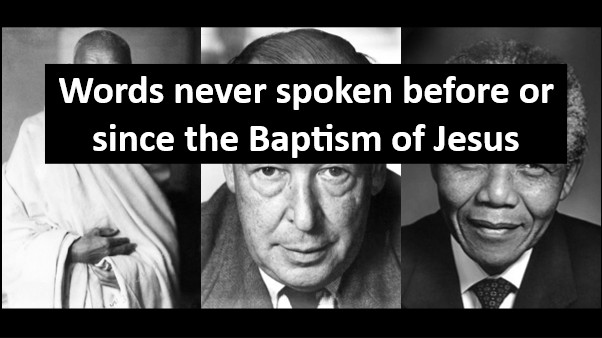
As I meditate on those words, I remember that John and his disciples, and later, Jesus and his disciples, baptized many. Probably thousands. Yet, because I know myself, because I’ve read the biographies of many great people like Gandhi and Mandela, because I’ve known hundreds of “good people,” I’m sure no voice from heaven said, I am well pleased with him, or her, when any other person was baptized.
The words “fulfil all righteousness” ring in my ears.
I wonder. Is the baptism of Jesus more than a commissioning, more than a shot fired to say the race has begun? I wonder if it’s an enactment of the great day of judgment which is to come. I wonder what words the voice will say to those who don’t admit their need for repentance, and who don’t respond positively to Jesus’ claims about himself, and his command, “come, follow me.”
I remember the Evangelist Mark telling us that Jesus said:
“I have not come to call the righteous, but sinners.”[4]
I remember the Apostle Paul writing to the young pastor, Timothy:
“Christ Jesus came into the world to save sinners.”[5]
I remember the Apostle Peter, writing to his congregations:
“[Jesus] himself bore our sins in his body on the cross, so that we might die to sins and live for righteousness.”[6]
I ask myself what it means “to fulfil all righteousness.”
On the day when churches around the world commemorate the Baptism of the Lord, I feel wet. Wet with tears. Tears over what the future holds for a world filled with self-righteousness, whether in Ukraine or Russia; or Palestine or Israel; or Cambodia and Thailand; or the USA or Venezuela; or Nigeria or Malaysia.
I remind myself that the church calendar begins by reminding us of the return of Christ, reminding us of the Day of Judgement, as I wrote in the column I titled “Why Advent Begins with the End: A Lesson from Matthew.”
Peace be with you.
[1] Most likely in Aramaic, the common language spoken in the area.
[2] Mark 1:11b; Luke 3:22c.
[3] C S Lewis put it famously: “A man who was merely a man and said the sort of things Jesus said would not be a great moral teacher. He would either be a lunatic—on the level with the man who says he is a poached egg—or else he would be the Devil of Hell. You must make your choice.”
[4] Mark 2:17.
[5] 1 Timothy 1:15.
[6] 1 Peter 2:24.

To learn more about Rama, click here.
Pingback: Baptism: Intimacy with the Father, Strange Solidarity with People – Bangsar Lutheran Church