
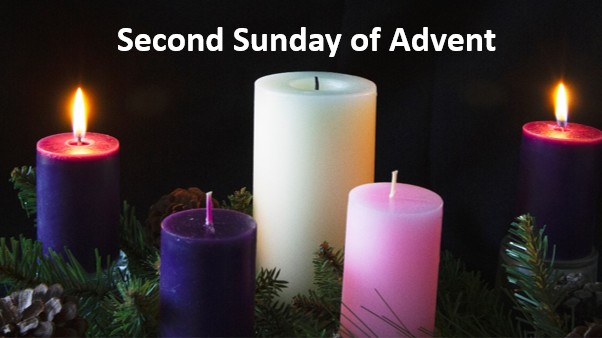
This Sunday is the second Sunday of Advent, the coming of Jesus. The lectionary invites us to ponder Matthew 3:1-12. The English Standard Version supplies the selection with the heading “John the Baptist Prepares the Way.”
Matthew is the first of the four gospels, accounts of the life and death of Jesus, in the Bible. In chapter one, we read of his genealogy. The first verse tells us he was royal, “the son of David.” The genealogy ends by telling us Jesus was called “Christ,” which means “saviour of the nation.”[1]
Chapter one ends with an angel speaking with Joseph. The angel came to him in a dream. The angel came because Joseph was about to register a divorce between himself and Mary. Because Mary had become pregnant, even though he hadn’t slept with her.
Joseph wanted to register a divorce rather than accuse Mary of having broken her marriage vow and slept with someone else. He wanted to exercise mercy.
The angel told Joseph no, don’t register a divorce. Because you’ve been chosen to protect her and her child, as her husband. Because the child’s father is the Holy Spirit, God. Because the child is the one promised by God through Prophet Isaiah; is the one who “will save his people from their sins,”[2] You must name the child “Jesus,” which means “God saves.”[3]
Matthew says Joseph, being a “just” man,[4] didn’t want to put Mary to shame. By saying this, Matthew challenges our idea of justice. Because we think justice requires shaming. But I won’t discuss this today.
Our text for today is in chapter three. Before I can explain it, I must lay out what’s in chapter two.
In chapter two, Matthew tells us of four other prophetic writings which were fulfilled in Jesus: one, he was born in Bethlehem; two, his parents took him to Egypt; three, many children were unjustly killed on account of his escape; four, his family returned to Nazareth and raised him up there.
In chapter two, Matthew writes “by the prophet” four times. Of the four gospels, Matthew is the one which is most clearly written as a book of fulfilment of prophecy. The gospels use the term “by the prophet”[5] 18 times. Of these, 13 are in Matthew.[6]
Now I come to our text. Here too, we find the term “by the prophet.” The chapter begins by introducing John Baptist. Matthew says, in verse 3:
For this is he who was spoken of by the prophet Isaiah when he said, “The voice of one crying in the wilderness: ‘Prepare the way of the Lord; make his paths straight.’”
Many preachers say John Baptist was the first prophet to appear during the period between Malachi, the last book of the Old Testament, and Jesus. But there’s evidence that other prophets also appeared during that period.
They signalled that they were prophets by choosing where they preached, how they dressed, what they ate, and what they preached.
They preached in the wilderness; they dressed differently from normal folks; they ate raw foods; they preached purity. Just like John Baptist.
In the first century, there was a Jewish historian called Josephus. He was not a Christian. In his writings, he included information about John Baptist, whom he considered a Jewish prophet. Josephus was himself, for three years, a disciple of Banus, who was a similar prophet.
John was similar, but different. He was a miracle-child. He was born to the elderly priest Zechariah and his wife Elizabeth. Elizabeth was past her childbearing years, but she conceived and bore a child after Zechariah encountered an angel in the Temple in Jerusalem. Also, we know that Elizabeth and Jesus’ mother, Mary, were cousins.[7]
Most importantly, John introduced an innovation. Unlike any previous prophet, he began to baptize Jews. He baptized them as an outward sign of repentance, of turning their lives around. He baptized them in the river Jordan, the river which marked the boundary between the wilderness years and their settlement in Israel, the land of promise.
John had a blunt message for Israelites who thought they were safe because they were descendants of Abraham, to whom God had promised the land. He said Israel was like a tree which failed to bear fruit. He said the tree’s owner had raised an axe to chop it down.[8]
Until John, baptism was reserved for proselytes, non-Israelites who wanted to join Israel. But John said there was a new kingdom, the kingdom of heaven. Even Israelites, descendants of Abraham, had to gain a visa to enter it. The visa was repentance and baptism.
In verse 2, we read that John said,
Repent, for the kingdom of heaven is at hand.
Matthew will later tell us that after John was arrested[9] by Herod Antipas, ruler of Galilee,[10] Jesus began his public ministry with the same words, “Repent, for the kingdom of heaven is at hand.”[11]
We often miss the impact of John Baptist.
People flocked to him from all over the land. Not because he performed miracles like healing or feeding. No. They flocked to him because they sensed that the time was ripe for national change, and that national change begins with personal change.
John Baptist’s tool was preaching.
He was arrested because his ruler considered him a threat to national security.
He was arrested because through his preaching he showed people that the hardships they experienced – cold, hunger, sickness, working for peanuts, being beaten and cursed – were the results of injustice.
He was arrested because he said that people must take responsibility for it, and now was the time – because God had flagged off the kingdom of heaven, a kingdom ruled by a king who demands justice and mercy.
Can you name any Christians in Malaysia who’ve been arrested because they demanded justice and mercy, because the government regarded their preaching as a threat to national security?
Peace be with you.
[1] In verses 16 and 17. “Christ” is the Greek translation of the Hebrew “Messiah.” The Oxford dictionaries offer two definitions of “Christ”: 1. the promised deliverer of the Jewish nation prophesied in the Hebrew Bible. 2. a leader regarded as the saviour of a particular country, group, or cause.
[2] Matthew 1:23 cites Isaiah 7:14, which says “they shall call his name Immanuel.” Matthew adds the explanation that Immanuel means “God with us.”
[4] See verse 19.
[5] Or “prophets.”
[6] Mark doesn’t use the term at all.
[8] Verse 10.
[10] And Perea.

To learn more about Rama, click here.
Pingback: Are You the One? Reflections on Matthew 11:2-11 – Bangsar Lutheran Church