
This Sunday, the lectionary invites us to meditate on Matthew 1:18-25. The English Standard Version supplies the passage with the heading “The Birth of Jesus Christ.”
The account begins after Matthew shows, using a condensed genealogy – which is a list of names of ancestors – that Joseph, the husband of Mary and the adoptive father of Jesus, is from the line of King David.[1]
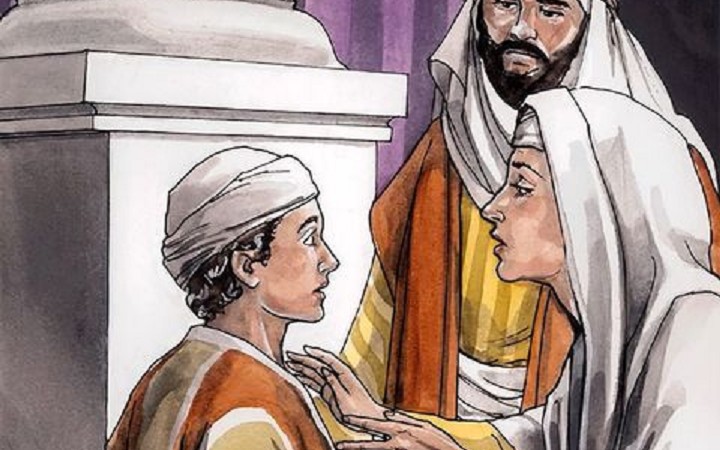
Then, he tells us Joseph learned that Mary, the woman to whom he was as good as married,[2] was pregnant. Joseph was shocked because he hadn’t slept with her. He wasn’t the father. Someone else was.
Joseph was “a just man;” a righteous man; a man who always did what the Bible[3] said he should do. What did the Bible say he should do?
Joseph knew what the book of Deuteronomy said.[4] God had ordained a very severe punishment for people who broke the marriage vow. He knew the punishment was public shaming, stoning, death.
Joseph also knew that God is merciful. He knew God had commanded that a “mercy seat” be made and placed in the heart of the tabernacle, the mobile temple. Then, he had it moved to the heart of the permanent temple after it was built. And Joseph often sang, with others, about the mercy of God.
So, Joseph resolved to show mercy. To quietly divorce Mary. Perhaps he thought her family would ship her off to live in a place where her supposed adultery could be kept secret, and mother and child kept safe. This was how families responded when sexual infidelity was exposed.
But God knew what Joseph was thinking, just like he knows every thought in every mind. So, God sent Joseph a message.
An angel appeared to Joseph in a dream, and told him:
“Joseph, son of David, do not fear to take Mary as your wife, for that which is conceived in her is from the Holy Spirit. She will bear a son, and you shall call his name Jesus, for he will save his people from their sins.”[5]
Notice the words: “son of David,” “Holy Spirit,” and “Jesus.”
Matthew, who wrote his gospel around the theme of fulfilment of prophecy, as I said last week, immediately adds:
“All this took place to fulfil what the Lord had spoken by the prophet: ‘Behold, the virgin shall conceive and bear a son, and they shall call his name Immanuel.’”
Since the prophecy says, “they shall call his name Immanuel,” why did the angel tell Joseph to name the boy “Jesus?” Why not “Immanuel?”
The answer is in two parts.
First, the name “Jesus” signals “Yahweh saves.” The chief idea is that of saviour, of someone who pulls us out of flood waters or out of fire; pulls us out of the harmful effects of sin.
Second, the name “Immanuel” signals “God with us.” This is how Jesus would come to be known, after his resurrection and return[6] to God. This is our experience when we pray with others, like Jesus told us to expect:
“For where two or three are gathered in my name, there am I among them.”[7]
It’s also in the promise Jesus attached to the Great Commission, which I touched on last week:
“Go therefore and make disciples of all nations, baptizing them in the name of the Father and of the Son and of the Holy Spirit, teaching them to observe all that I have commanded you. And behold, I am with you always, to the end of the age.”
“I am with you always.” Jesus is our Immanuel, God with us.
Joseph practiced mercy. He protected Mary’s honour. He welcomed God’s intrusion in his life. He protected Mary’s son.
Does God still intrude in people’s lives? Today, who practices mercy? Who needs to be honoured and protected?
The name “Joseph” is from the Hebrew yosef, which means “taken away.” The first Joseph in the Bible is the son of Rachel.
For years, Rachel endured reproach: she was shamed and scolded because she was childless. Finally, she bore a child. She named the child Joseph, because through him, her reproach was yosef, was taken away.
In the Bible, the church is called the Bride of Christ.[8]
Today, churches around the world bear much reproach.
When people share stories about churches, they choose stories of exploitation and greed. Or stories of promises of personal peace and abundance, affluence. Not of mercy, honour, protection. Why?
What can you and I do to change the narrative?
Peace be with you.
[1] Perhaps I should say “tries to show,” because it’s a near-impossible task. I mean, he starts with Abraham, who was born more than 2,000 years earlier. And the last book of the Hebrew Bible dates from about 400 years earlier. So, there’s a huge gap in the records which contain the ancestors’ names.
It’s not as if Joseph was campaigning to become king, constantly announcing his genealogy. Also, Matthew does two very unusual things: first, he includes four women; and second, none of the women are descendants of Abraham.
Matthew crafted the genealogy very carefully, to serve a purpose. But I’ll have to leave it to another time to draw out the deep meaning in it.
So, Matthew “proves” with the genealogy that Joseph was from the line of David.
[2] In those days, being betrothed was legal, like our registry weddings. The next step, a marriage service, was just a social event. Breaking a betrothal required a divorce.
[3] Of course, in those days, there was no “Bible” in the form we know it today. It would be more accurate to say “the scriptures.”
[4] Deuteronomy 22:13-21.
[5] Verses 20-21.
[6] Often called ascension.
[7] Matthew 18:20.
[8] See Ephesians 5:22-33; 2 Corinthians 11:2; Revelation 19:7, 21:2.

To learn more about Rama, click here.
Pingback: Words never spoken before or since the Baptism of Jesus – Bangsar Lutheran Church