
This Sunday, the lectionary invites us to ponder Matthew 24:34-46. The English Standard Version supplies the headings “The Great Commandment,” and “Whose Son Is the Christ?”
The reading is part of Matthew’s account of the last public encounter between Jesus and the religious leaders before they arrested him. The setting is the Temple in Jerusalem.
His opponents repeatedly interrupt his teaching session. They repeatedly try to trap him into saying things which would cause people to lose confidence in him. They repeatedly fail.
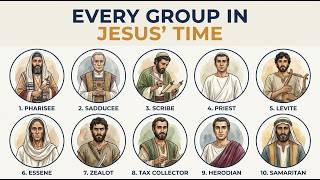
Opposition to Jesus unites three traditionally warring groups: the Herodians, the Sadducees, and the Pharisees. Think of them like members of political groups.[1]
Each group mounts separate attacks on him. The Herodians ask him about paying taxes to Caesar – I discussed this last week.[2] The Sadducees ask Jesus about life in heaven.
Now the Pharisees step in. They ask Jesus, “which is the greatest commandment?” Like the questions of the Herodians and the Sadducees, whatever answer Jesus gave could be challenged. It’s like playing chess. The Masters know all the moves an opponent can make in response to any one move. The objective is not to gain insight from a conversation partner. The objective is to publicly humiliate an opponent.
The Pharisees had a list of 613 commandments. They strived to obey all of them. Naturally, they regarded some as “light” and others as “weighty.” For example, commandment #433, “offering up incense twice daily,”[3] may be considered light, while #40, “Not to afflict an orphan or a widow,” may be considered weighty – depending on which Rabbi was doing the weighing, and what the context was. Perhaps all Rabbis would agree that not committing murder is much heavier than eating pork.
But Jesus wasn’t interested in exhibitions of debating and mocking skills. He didn’t pick any of the 613 commandments[4] or any of the Ten Commandments. He picked instead the motive behind all the commandments, the motive behind all the rules for good living. He named two commandments, which he called the first and the second. He said,
“You shall love the Lord your God with all your heart and with all your soul and with all your mind. This is the great and first commandment. And a second is like it: You shall love your neighbour as yourself.”
That hit between the eyes of the lawyer – the skilled debater – who had put the question to him. This man, this Pharisee, saw that Jesus was no ordinary man. He saw that Jesus wasn’t interested in winning. He saw that Jesus was interested only in pleasing God. He wasn’t going to discuss the scriptures as if they were playing a board game. He backed off.
But Jesus wasn’t finished. He changed the subject. He asked the Pharisees, “What do you think about the Christ? Whose son is he?” Their answer was quick. They said, “The son of David.”
The situation in Jerusalem, in Judea, was like it was in Malaya during the Japanese Occupation. The Romans were as exploitative and as brutal as the Japanese were in Malaya during the second world war.
Just as our Malayan ancestors longed for a saviour, the Jews longed for a saviour. They longed for the person mentioned in their scriptures, the Bible. They longed for the Christ, the Messiah, whom they thought of as a military leader, like David. They called him “son of David.”
This is why the Evangelists Matthew, Mark and Luke tell us so many people addressed Jesus as “Son of David.” Matthew uses the term in his genealogy of Jesus and in the angel’s announcement to Joseph about Mary’s pregnancy. He says blind men, and a Canaanite woman, addressed Jesus as Son of David. He says crowds welcomed Jesus-on-a-donkey into Jerusalem as the Son of David.
So, it’s no surprise that the Pharisees answered that the Messiah was the son of David.
Jesus now points them to the scriptures, to Psalm 110. He points out that in this psalm, David, led by God’s Spirit, addresses his son as his Lord. He asks them to explain this.
With his question, he challenges them to stop thinking of the Bible as a book of rules, of commandments; and to think of it instead as a book of revelation of the plan of God.
But they are so locked into their way of thinking about the Bible, that their engines stall, stop. Matthew reports,
“And no one was able to answer him a word, nor from that day did anyone dare to ask him any more questions.”
How do we read the Bible? As a book of instructions, or as a book of insights into God’s heart and his plans for the world and for us?
Peace be with you.
Image credit: Deep Made Simple.
[1] For example, in Malaysia today, Umno, ABIM, Perkasa.
[2] https://bangsarlutheran.org/matthew-22-is-it-lawful-to-pay-taxes-to-caesar-or-not/.
[3] I’m relying on https://www.jewfaq.org/613_commandments.
[4] A compilation of all the commandments found in the Hebrew Bible (Old Testament).

To learn more about Rama, click here.