
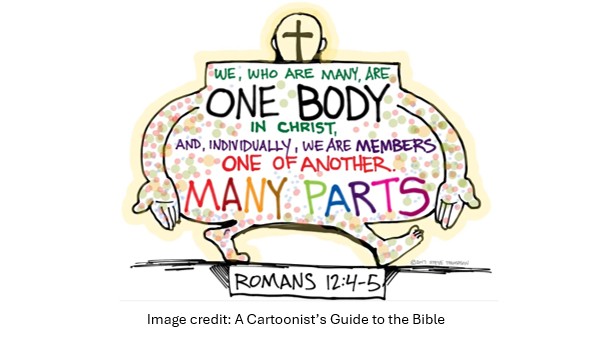
This Sunday, the lectionary invites us to ponder Romans 12:1-8. The English Standard Version supplies verses 1-2 with the heading, “A Living Sacrifice,” and the heading, “Gifts of Grace” to verses 6-8.
The book of Romans is a letter the Apostle Paul wrote to Christians in Rome. It’s quite remarkable that he did so, because at the time he wrote it, he’d never visited Rome, the capital of the Roman Empire, the seat of imperial power. The fact that Paul wrote to them shows how well-known he was, and how confident he was about what God had called him to do.
We know what God had called him to do, because he began the letter by writing about it. He wrote,
Paul, a servant of Christ Jesus, called to be an apostle, set apart for the gospel of God, which he promised beforehand through his prophets in the holy Scriptures, concerning his Son, who was descended from David according to the flesh and was declared to be the Son of God in power according to the Spirit of holiness by his resurrection from the dead, Jesus Christ our Lord, through whom we have received grace and apostleship to bring about the obedience of faith for the sake of his name among all the nations, including you who are called to belong to Jesus Christ,
The word “apostle” signals a person sent on a mission, to spread a belief. The word “gospel” means good news. So, Paul introduced himself as an ambassador with good news, sent by God, the most powerful being anyone can imagine. This is like the Ambassador of Norway, one of the most generous countries in the world, telling you she has good news for you.
Why did Paul write to the Romans? We know the answer from the way he ends his letter. He ends by greeting many people whom he regards as his special friends in Rome. He greets Prisca and Aquila, whom he describes as self-sacrificing “fellow workers in Christ Jesus.”[1] He greets his relatives, Andronicus and Junia. So, we can deduce that he wrote to them because he’d heard about challenges their churches were facing and wanted to respond to their pleas for guidance.[2]
They faced many challenges. As I pointed out in my reflection on Romans 9-11, although Christian beliefs and practices are rooted in the Jewish scriptures, very few Jews recognized Jesus as the promised Messiah. In the early church, this raised the question of whether Christians should accept being identified as a sect of the Jews, and whether Jewish Christians should continue to identify as Jews.
The question of identity was with them then and is with us now. We saw this very clearly in the recent elections in Johor and in Negeri Sembilan. When campaigning, many parties and politicians urged people to vote for candidates on the basis of their race rather than their integrity. This campaign strategy, like so often before, proved successful: because the winner was a coalition whose leader came within a hair’s breadth of being convicted by a court as a felon.[3] A leader who continues to insist that his predecessor, a felon convicted after three trials, be “pardoned” despite refusing to admit that he committed crimes.
That electoral result, which reflects the minds of politicians and voters, is the background against which we read today’s passage. I’ll limit my reflection to the first two verses, which read:
I appeal to you therefore, brothers, by the mercies of God, to present your bodies as a living sacrifice, holy and acceptable to God, which is your spiritual worship. 2 Do not be conformed to this world, but be transformed by the renewal of your mind, that by testing you may discern what is the will of God, what is good and acceptable and perfect.
I mentioned the minds of politicians and voters. Notice that Paul uses the word “mind.” After laying out 11 chapters of theology, things we hold to be unquestionably true, Paul moves on to application, to what we must do with our lives. The father of Bishop Peter Storey, a South African anti-apartheid activist, understood that theology is the root of practice. In one of his memoirs,[4] the Bishop writes that his father told him, “everything begins in theology and ends in politics.”
Like Paul, Storey’s father understood that most leaders just want to retain power. Paul understood that most leaders use power to arouse fear in people, to prevent them from seeing things differently. Paul understood that he himself had used the power of denouncing, stoning and killing, to persuade people not to adopt new teachings, new theology.[5] Paul understood that only people whose minds are transformed can see that most leaders are more interested in themselves than in God.
Paul reminded the churches that leaders won’t give up power easily. This is why he began the application part of his letter by mentioning sacrifice. He said Christians have to adopt a life of sacrifice – have to accept that being Christian means living like Jesus, challenging power. Challenging power through the exercise of passive resistance. The kind of resistance which Jesus employed. The kind of resistance which got Jesus crucified.
Paul adopted the language of the Jewish scriptures when he told people they had to become living sacrifices. They knew what he meant. In the era of the new covenant, established through the sacrifice by crucifixion of Jesus, there are no more sacrifices at the temple in Jerusalem: no grain sacrifices, no animal sacrifices. Now, there’s only one sacrifice: the sacrifice of praise offered through bodies joined together as the new body of Christ, working out the Nazareth manifesto of Jesus,[6] which reads:
“The Spirit of the Lord is upon me
because he has anointed me
to proclaim good news to the poor.
He has sent me to proclaim liberty to the captives
and recovering of sight to the blind,
to set at liberty those who are oppressed,
to proclaim the year of the Lord’s favour.”That’s the work of the church, comprised of many members, with many gifts, working together. Are we doing the work? How well are we doing it?
Peace be with you.
[1] Paul mentions this couple in Romans 16:3, 1 Corinthians 16:19, and 2 Timothy 4:19. Luke mentions them in Luke 18.
[2] We speak of churches, not “the church.” Because there were several of them. in the early years, churches didn’t meet in purpose-built buildings. They met in homes.
[3] See for example this January 2026 article in The Edge: Civil groups demand AGC explain Zahid’s NFA decision, having proved prima facie in Yayasan Akalbudi case, https://theedgemalaysia.com/node/788665.
[4] Protest at Midnight: Ministry to a Nation Torn Apart. Published by Cascade Books in 2022. You can read a review of it here: https://melanniesvobodasnd.org/bishop-peter-storey-a-candle-at-midnight/.
[5] See for example, Acts 7, which describes Paul’s lead role in the martyrdom of Stephen.
[6] Luke 4:18-19.

To learn more about Rama, click here.
Pingback: Romans 12: The Politics of Genuine Love – Bangsar Lutheran Church