
This Sunday, the lectionary invites us to ponder Matthew 13:24-30 and 36-43. The English Standard Version supplies the headings, “The Parable of the Weeds,” and “The Parable of the Weeds Explained.”
Three years ago, I published a commentary on the same reading. I titled it with the question, “Don’t pull out the weeds?” You can click the link to read it. It includes this summary of the parable:
A farmer sows his field with seeds of wheat. At night, an enemy does something illegal. He sows seeds of a weed on the same field. He sows Darnel, a poisonous plant which “looks like” wheat while it’s growing. It can only be detected after it’s grown awhile. After a while, the farmer detects the weeds. He decides not to uproot the weeds till harvest time.
I concluded the commentary by quoting a theologian who wrote,
“… the parable emphasizes the fact that the function of the divine sovereignty in this time is to save men, not to judge them.”
And I followed that with a final application-focused comment. I said,
“[Be afraid of] weeds. Watch out for weeds. Be sure you’re not a weed. Be comfortable with uncertainty.”
On Sunday 12 July, I preached a sermon titled, “The Role of Scripture and the Spirit.” I concluded with the words,
“The Role of Scripture and the Spirit is to reveal to us the purpose of God for the world, despite our tendency to be idolaters. To apply the truth of God to scold us, to correct us, to teach us, to train us in the ways of God. To turn us into men and women of God. To reflect his glory everywhere in the world.”
In the sermon, I told my church that we will face controversies and disappointments. I said sometimes members will leave us and publicly condemn us.
Today, while pondering the reading, I recalled some controversies over 20 centuries of church history. I asked myself how leaders of the church were guided by this parable when they had to deal with them. I find the history very instructive.
Take for example the sexual abuse of minors by clergy. Did church leaders appeal to the parable and say, “we’ll let these clergy remain in service, and in the church”?
Certainly, they considered the parable when they were thinking about what had happened, and how they should respond. For example, I learned that in 2005, Cardinal Ratzinger – who would later become Pope Benedict – wrote a text for the Stations of the Cross on Good Friday 2005 at Rome’s Colosseum, in which he said,
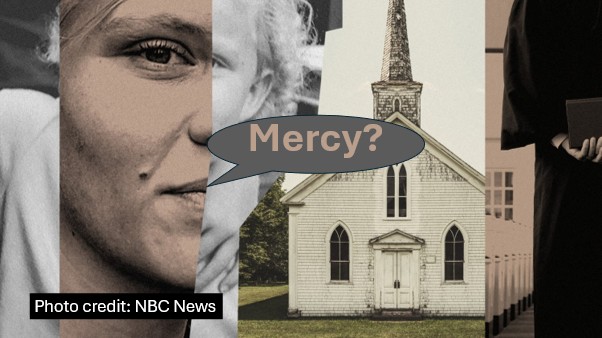
In your field we see more weeds than wheat. The soiled garments and face of your Church throw us into confusion. Yet it is we ourselves who have soiled them! It is we who betray you time and time again, after all our lofty words and grand gestures. Have mercy on your Church; within her too, Adam continues to fall.
Nevertheless, churches acted against clergy who abused their positions.
From the Bible, we know that the church has an exalted place in God’s plans. It’s called the body of Christ, and also the bride of Christ. One theologian neatly summarized what the church is to be. He said, “it’s an outpost of heaven.” Churches should be windows into heaven, the most desirable destination anyone can dream of.
From our experience of churches, we know that all members fall short of God’s standard. In fact, we know the most accurate statement we can make about churches is that they are filled with sick people, sinners; constantly in need of healing, of forgiveness. So much so that our favourite scripture is the text in which Jesus says,
“… Those who are well have no need of a physician, but those who are sick. I came not to call the righteous, but sinners.”[1]
I think every pastor I know will agree with John Calvin’s observation that,
“So long as the Church is on pilgrimage in this world, the good and the sincere will be mixed in it with the bad and the hypocrites.”
I struggle over the fact that most churches in Germany accepted members of Hitler’s Nazi party as Christians. I struggle over the fact that the Catholic Church of Chile accepted the brutal dictator Augusto Pinochet as a member. I struggle because, as I noted in my earlier commentary, the apostle Paul put some people out of his churches.[2]
But I rejoice over the fact that some of the most humane Christian theology has its roots in late 20th century Germany. It seems that may “weeds” who were allowed to grow in German churches turned into “wheat” and brought honour to God in Christ.
Perhaps what we are to see in the parable is that even though there are many weeds, many people who are obviously hypocrites, in the churches, there will continue to be good people. In fact, they will grow in numbers. As Jesus says, in the harvest, in the judgment, at the end of time, God will acknowledge them.
Peace be with you.
[1] Mark 2:17.
[2] E.g. 1 Corinthians 5:1-13; 2 Thessalonians 3:6-14; Titus 3:10. But see also 3 John 1:9-10.

To learn more about Rama, click here.