
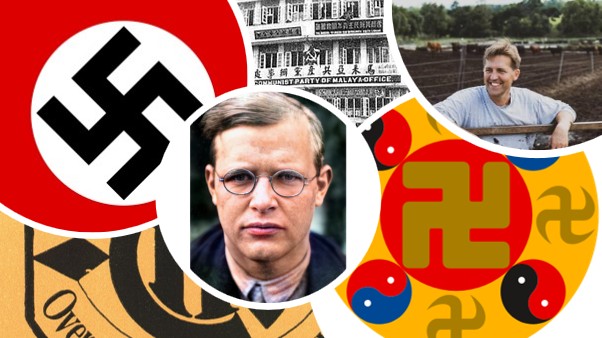
This Sunday, the lectionary invites us to ponder Matthew 10:24-39. The English Standard Version presents the text in two parts and supplies the headings “Have No Fear,”[1] and “Not Peace, but a Sword.”
The chapter begins with Jesus sending the Twelve apostles on a mission. To the Israelites, the Jews. To announce the beginning of the end.[2]
To announce that the kingdom of God, ruled by David’s descendant, Jesus, had come. A kingdom with no exploitation, no injustice, no false worship: the kingdom which the Israelites had failed to establish. A kingdom in which the supreme law is “Love the Lord your God with all your heart and soul and mind, and your neighbour as yourself.”[3]
The healings and exorcisms conducted by Jesus – and his disciples when he sent them out on missions like the one described in last week’s passage – had a huge national impact. Impact like that of the Falun Gong health and healing movement[4] in China in the 1990s.
Initially, the government was happy, because thanks to Falun Gong, there were fewer unhealthy people seeking treatment in hospitals. The government even adopted some practices promoted by Falun Gong.
Later, as Falun Gong practitioners began to number in the millions, the government, which was atheistic, felt threatened by the spirituality of Falun Gong. Felt so threatened that it persecuted members of Falun Gong.
But the government also began to improve national health services – so that the taunts of Falun Gong promoters could be drained of truth: just like in the 1950s in Malaya when the British introduced improvements in Chinese “new villages”[5] in response to taunts by the Communist Party.[6]
My point is that when non-governmental actors effectively promote goals, visions, and teachings which are different from what’s promoted by the government, the government responds. Responds with persecution. This is why Jesus, after commissioning the Twelve, spoke of persecution.
Jesus knew that the first result of their mission would be joy; but it would soon turn into fear – fear among the Twelve and among those who believed what the Twelve taught about the Kingdom of God. Matthew emphasizes this by using the phrase “fear not” three times.
Matthew designed his gospel as a manual of instruction for believers, for people who’ve deposed their own selves from the thrones of their own lives. For people who’ve replaced themselves with Jesus. Matthew tells them Jesus said one of the results of effective preaching would be suffering.
Suffering to be endured by the messengers of Jesus, as well as by those who respond to their message. Suffering which their families and neighbours would regard as shameful. Why? Because the suffering would be inflicted upon them by the government, as punishment.
Jesus used a striking figure to explain both the severity and shame of the suffering which would come upon them. Jesus said they must take up their crosses and follow him.[7] The result would be as shameful to my family as a Court pronouncing my mother guilty of prostitution and ordering her to be marched naked down the middle of Jalan Tuanku Abdul Rahman in KL, with a board around her neck, saying “lover of her neighbours.”
Matthew used Jesus’ words to teach the disciples that the impact of the gospel will be political. Will result in action by the state. Action to shame Christians. To shame them into silence. To shame them into not proclaiming Jesus as the benchmark of law, performance, and judgment.
My reading of today’s text is coloured by my reading of “Redeem the Time: What Ben Sasse Teaches Us About Life, Death, and Politics.” It’s an article by Alex Harris, published in April this year by the Keller Center.
“‘[Sasse says let’s] have one or two cheers for politics, neither zero nor three.’ To have zero cheers for politics means ‘pretending the world isn’t broken,’ while three ‘pretends power and coercion could be the center of your worldview.’ Either approach is an error for the believer. …
Sasse’s observation here is a simple diagnostic for our hearts: What elicits our enthusiasm, and to what degree? Have we turned our backs on politics, fed up with the current climate—a zero-cheers approach? Or have we allowed it to supplant our true source of hope and become all-consuming—a three-cheers approach?”[8]
I wonder whether the vast majority of churchgoers are aided and abetted by their pastors, teachers, and friends, to avoid the hard, shaming, killing, work of proclaiming the Kingdom of God: A kingdom in which laws are just, and no one is above the law. A kingdom in which there are no fat rich men or poor starving men.[9] A kingdom unlike today’s world in which,
“the top 10% of the adult population own about 75% of all global wealth, while the poorest 50% hold just 2%.”[10]
During the Nazi era in Germany, the martyr-pastor, Dietrich Bonhoeffer, wrote his famous book, The Cost of Discipleship. He devoted chapter 25 to a reflection on today’s passage. He titled it “Decision” and placed it in a section which he titled “The Messengers.” He wrote,
“The final decision must be made while we are still on earth. The peace of Jesus is the cross. But the cross is the sword God wields on earth. It creates division. The son against the father, the daughter against her mother, the member of the house against the head – all this will happen in the name of God’s kingdom and his peace.”
Is the cross creating divisions? What decisions must you and I make? Are we blunting the sword of the cross?
Peace be with you.
[1] For verses 26-33.
[2] I reflected on this last week.
[3] Adapted from Matthew 22:37-40.
[4] According to one widely-repeated definition, “Falun Gong, also called Falun Dafa, is a high-level cultivation practice guided by the characteristics of the universe – Truthfulness-Compassion-Forbearance.”
[5] Between 1950 and 1954, during the Malayan Emergency (1948-1960), the colonial government forcibly moved about 570,000 rural Chinese into about 509 “New Villages,” surrounded by barbed wire and patrolled by armed guards. The inmates called these places concentration camps; they were body-searched before they left for work daily, subjected to curfews, and strict rules including limits on food they could pack for lunch. 30% of Malayan Chinese were displaced. It’s not even mentioned in the national school history syllabus. The operation – which shaped today’s Malaysia, was part of the “Briggs Plan,” designed to end support for communist resistance fighters. Christian missionaries, many forced out of China by Mao Zedong, established mission work – with medical and educational services – in the “villages.” It was a period of rapid church growth. Tan Teng Phee’s 2020 book Behind Barbed Wire is the latest scholarly study of new villages. Click here to read an 18-page account of it in Bandung Journal of the Global South: 10(2023).
[6] Including not only clinics and schools, but also local elections. On my personal blog, you can read my 6-instalment account of Elizabeth Goldsmith’s, Against All Odds: God at work in an impossible situation (Milton Keynes: 2007)
[7] Verse 38.
[8] https://www.thegospelcoalition.org/article/sasse-life-death-politics/.
[9] See Jesus’ parable of the Rich Man and Lazarus, Luke 16:19-31.
[10] https://wir2022.wid.world/executive-summary/.

To learn more about Rama, click here.
Pingback: Matthew 10: Seriously? Jesus Promised us the Reward of the Prophets? – Bangsar Lutheran Church