
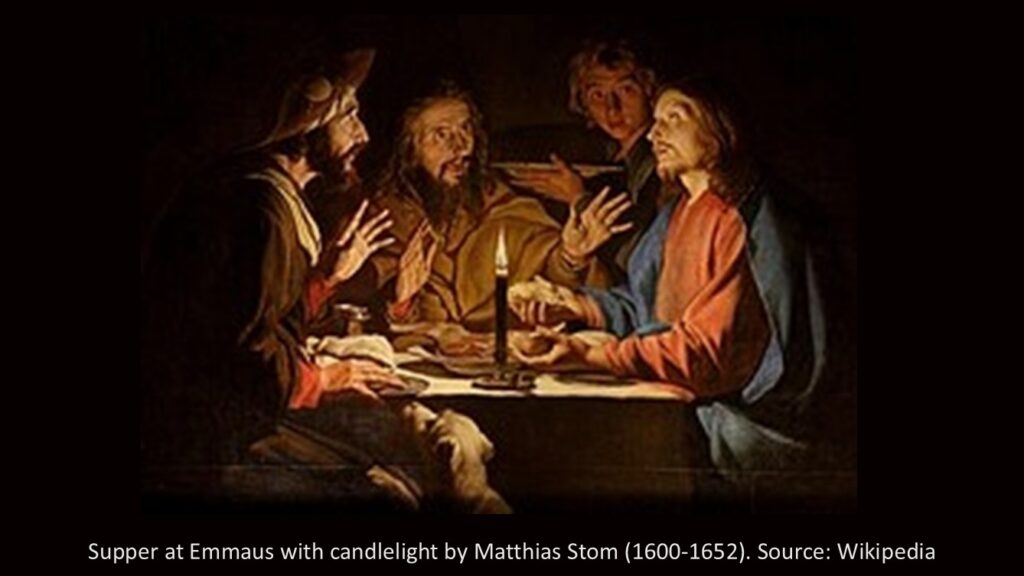
This Sunday, the lectionary invites us to ponder Luke 24:13-35. The English Standard Version supplies the heading “On the Road to Emmaus.”
It’s the third day, Resurrection Sunday. The day the women found Jesus’ tomb open. The day Peter and John saw that there was no body in the tomb. The day Jesus appeared to Mary Magdalene, who thought he was the gardener. The day Jesus appeared to many, in a locked room.
Luke tells us that on that day, two of the disciples[1] were walking to Emmaus, a journey which would’ve taken them about three hours. He names of one of them: Cleopas. He doesn’t name the other.
Luke tells us that as they were walking, someone joined them. It was Jesus. But they didn’t recognize him. Luke says God prevented them from recognizing him. Presumably because if they had recognized him, the conversation they needed to have couldn’t have happened.
Jesus joined them. Listened to their conversation. Saw that they were very downcast, dejected, long faced. He asked them why. They looked at him with surprise. They asked how he could be unaware. They asked how he could not know what had just happened in Jerusalem.
Ironically, they told Jesus what the elders and chief priests had done to him. Notice they didn’t add Pilate or Caesar, or the Roman government.[2]
Cleopas said to Jesus, “[though] Jesus of Nazareth, … was a prophet mighty in deed and word before God and all the people,” “our chief priests and rulers delivered him up to be condemned to death and crucified him.”
Cleopas said they were sad because they had thought Jesus would liberate Israel; save Israel from oppression by the Romans. But Jesus was killed. And now, his body was missing and angels had told some women that Jesus was alive. Some men had confirmed that his body was missing.
They were very sad. They felt they had invested so much of their lives in Jesus, for the sake of their nation, and got nothing in return. Like Thomas, whom we read about last week, they appear to have decided to jump ship. To write off their investment. To go back home.
The “stranger,” rebuked them. Scolded them. He said,
“’O foolish ones, and slow of heart to believe all that the prophets have spoken! Was it not necessary that the Christ should suffer these things and enter into his glory?’ And beginning with Moses and all the Prophets, he interpreted to them in all the Scriptures the things concerning himself.”
That’s the account of the first Bible study recorded in the Bible. Except that they didn’t have the written words with them. What they did have is the person, God, who inspired the authors of the books of the Hebrew Bible, what we call the Old Testament. They had Jesus.
Jesus showed them how to read the Bible through the cross and the resurrection. He stressed that suffering is the lot of prophets and teachers of the word. Here’s a quick list of scriptures he may have pointed out:[3]
- Genesis 3:15 The “Seed of the woman” who would defeat Satan.
- Genesis 22:18 The promise to Abraham that his seed would bless all nations.
- Exodus 12:5 The Passover Lamb without blemish.
- Numbers 21:9 The serpent on a pole, foreshadowing Christ being lifted up.
- Psalm 16:10 The promise that God’s Holy One would not see decay.
- Psalm 22:1, 7-8, 18 Explicit details of the Crucifixion – forsakenness, mockery, casting lots.
- Isaiah 50:6 & 53 The Servant who gives his back to smiters and is pierced for transgressions.
- Jonah 1:17 The sign of Jonah – three days in the earth.
When they arrived in Emmaus, the disciples invited Jesus to share their food. Jesus took it upon himself to give thanks for the food. When he broke the bread, said the blessing, and gave it to them, they recognized him. Immediately, he “vanished from their sight.”
The encounter on the Emmaus road is reported only by Luke. We don’t know why he named Cleopas. We know very little about Cleopas – some have suggested that he’s Clopas,[4] husband of Mary, who stood at a distance and watched Jesus’ crucifixion.[5]
I believe Luke included this account in order to show us the concern Jesus had for all his disciples. He didn’t want any of them to jump ship after he was killed. So, he sought out Cleopas and his buddy, and later, Thomas.
I believe Luke included this account of Jesus teaching how to read the Bible to disciples who were not members of the twelve, to show us that God does not limit the role of teaching to elites within the church.
I believe Luke included the element of response, of “burning within the hearts,” and of “return to tell the others,” to give us a model to recognize when members of our congregations experience and do the same things.
How often do we have such experiences and share in like manner?
Peace be with you.
See also “The Meal That Opened Their Eyes: Genesis, Emmaus, and Us,” by another BLC member, Davin.
[1] The word disciple is important. It means “a dedicated follower, pupil, or apprentice who learns from a teacher, accepts their teachings, and helps spread them. … [it] implies active application of learning, not just passive listening.”
[2] The Apostles Creed and the Nicene Creed mention Pontius Pilate, but not the elders and chief priests.
[3] Of course, in those days chapters and verses were not numbered.
[4] John 19:25.
[5] Others have suggested he is the younger brother of Jesus’ adoptive father, Joseph. And that “the other disciple” was Mary, Cleopas’ wife. See for example, https://www.christianity.com/jesus/death-and-resurrection/resurrection/who-were-the-disciples-on-the-road-to-emmaus.html. For a suggestion that Cleopas is a pseudonym for Apostle Peter, see https://www.ritmeyer.com/2021/03/23/the-road-to-emmaus/.

To learn more about Rama, click here.