
This Sunday, the lectionary invites us to ponder John 20:19-31. The English Standard Version presents the text in three parts, under the headings “Jesus Appears to the Disciples,” “Jesus and Thomas,” and “The Purpose of This Book.”
The disciples included the 12 apostles: the 12 men whom Jesus had chosen and kept with him for the last three years of his life. As I’ve said before, there are four accounts of Jesus, four Gospels. All focus on telling us who Jesus was, especially through his crucifixion and resurrection.[1]
Today, we have many translations of the Bible. We know the prophecies about Jesus in the scriptures which we call the Old Testament.[2] Today, to us, it seems astonishing that the disciples didn’t understand that Jesus had to die and rise again. And that the Apostles didn’t hide their ignorance.
But those are the facts.
Last week,[3] we read about Mary Magdalene, Peter, and John. They didn’t expect Jesus to be resurrected. They didn’t know what to make of his resurrection. Why was Jesus resurrected? Was his resurrection good news? How was it good news?
They were perplexed. They were scared. Terrified. Stayed behind closed doors. John explicitly tells us, in verse 19, that they feared the Jews.
Why did they fear the Jews?
They feared the Jews because they were themselves Jews and knew how their leaders thought. They knew how much the Jewish leaders felt threatened by them. They knew the Jewish leaders thought they were as much a threat to their privilege and wealth as Jesus had been.
They believed the leaders were looking for them. To charge them for the offence of refusing to recognize Caesar as Lord and king. To falsely charge them as insurrectionists. They expected to be crucified, as cruelly as Jesus had been. They were terrified. They locked themselves in a house.
We’re not told how many disciples were in the house. We know all the apostles were there, except Thomas. Why wasn’t he there?
We’re not told. But there’s a hint: John introduces Thomas as “one of the twelve.” This is ominous because John also introduced Judas as one of the twelve.
About Thomas, the other Gospels only tell us that he was one of the twelve. Nothing else. But John tells us several things about Thomas.
John tells us that when Jesus wanted to undertake the risky appearance in Judah to visit Lazarus, Thomas burst out that they should go with him and die with him.[4] John also tells us that when Jesus told them “you know the way to where I am going,” Thomas said, actually, we don’t know.[5]
So, why was Thomas absent that evening, on Resurrection Sunday?
I suspect Thomas was absent because he’d decided to abandon the disciples. He thought okay, three years have passed, things are getting really hot, we’re directionless, I’m quitting.
But his buddies – who apparently valued him – told him that Jesus had risen from the dead. He thought they were nuts. He said,
“Unless I see in his hands the mark of the nails and place my finger into the mark of the nails, and place my hand into his side, I will never believe.”
He was adamant. But he sensed that something had changed in his buddies. So, he stayed with them.
They were still terrified. They still kept the doors locked.
After eight days, Jesus came.
Again, Jesus didn’t knock and wait for them to open the door. Again, he just appeared among them.
As John tells it, Jesus immediately directed his attention to Thomas. The words Jesus spoke to Thomas showed that he knew what Thomas had said to the others. Jesus said to Thomas,
“Put your finger here and see my hands; and put out your hand, and place it in my side. Do not disbelieve but believe.”
Thomas didn’t need to. In that moment, Thomas knew he couldn’t abandon ship. Because in that moment, Thomas experienced the magnetic, irresistible grace of Jesus. In that moment, Thomas addressed Jesus using the address for the Emperor: “My Lord and my God.”
The special words Jesus spoke to Thomas, to reassure him that he was still chosen to be his representative on earth, to be one of the twelve, show us how to understand the words Jesus said to the terrified disciples on the evening of Resurrection Sunday. He said to them,
“If you forgive the sins of any, they are forgiven them; if you withhold forgiveness from any, it is withheld.”
Those words have been understood in different ways over the centuries. Some streams of Christian faith have taken it as giving power to priests – and pastors – to forgive or not to forgive sins.[6] But I think Jesus was referring to the sin of Thomas, the sin of unbelief.
Protestants often speak of collective leadership of churches. This is why we have local committees which are responsible for each congregation. We call them “councils.”[7]
Sometimes members don’t agree with others, and go off in a huff. I think Jesus, in his words to Thomas,[8] demonstrated a practical outworking of what it means to wash one another’s feet.
In every community, there will be disagreements. We must learn to accept them. We must live out of the conviction that just as the disciples, with the best teacher ever, were slow to understand, we too will be slow to understand. We must persevere, not jump ship.
Peace be with you.
[1] In today’s reading, in verse 31, John says he has written “so that you may believe that Jesus is the Christ, the Son of God, and that by believing you may have life in his name.”
[2] Matthew, also one of the twelve apostles, quotes the Old Testament 50-60 times. If we include allusions, the count exceeds 90.
[3] In my column titled “He Is Risen: Eyewitnesses and the Birth of Faith.”
[4] John 11:16, “Let us also go, that we may die with him.”. Like most of us today, Thomas had an evidence-based personality. On their previous visit to Jerusalem, the Jews had tried to kill Jesus by stoning him. See John 8:59, 10:31.
[5] John 14:5.
[6] See for example, this article in Catholic Answers, “When Would a Priest Withhold Absolution?” https://www.catholic.com/magazine/online-edition/why-would-a-priest-refuse-to-forgive.
[7] Named after the Jerusalem Council described in Acts 15:1-35.
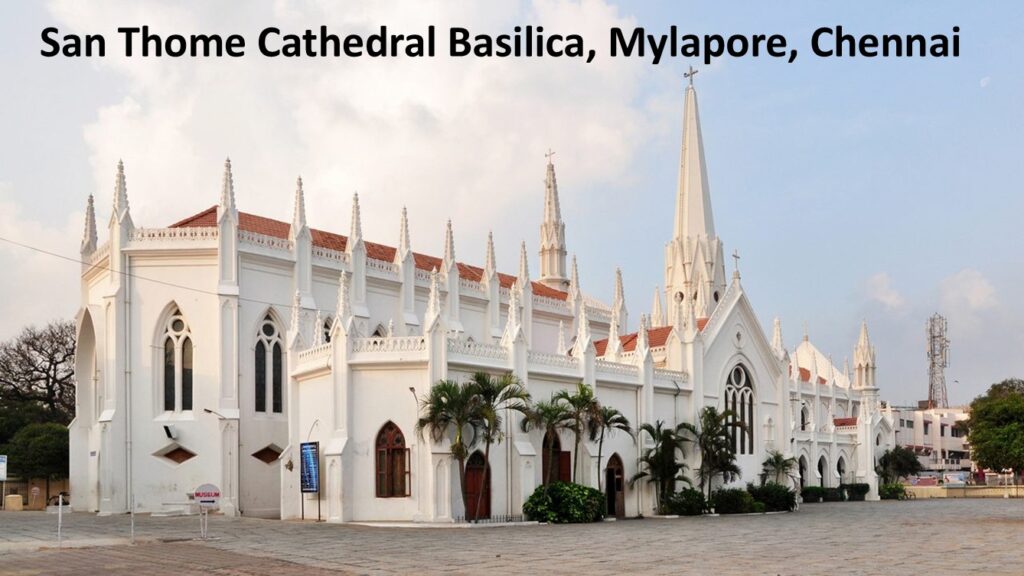
[8] According to legend, Thomas later departed for India and established several congregations, before being martyred in Mylapore near Chennai.
Today, you can visit San Thome Cathedral Basilica in Mylapore and view bones claimed to bi his, and a fragment of the spear with which he was allegedly killed. The church is one of three in the world which claim to be built on the tombs of one of the twelve. The other two are St Peter’s in Rome and Santiago de Compostela in Spain, claimed to be the site of the tombs of Peter and James, respectively.
One of the little-reported stories about the Compostela is a depiction of “St James” slaying “Moors.” You can look up “Santiago Matamoros,” which means “St James the Moor [Muslim] slayer.” The Khan Academy has a short video about a life-sized sculpture of Santiago Matamoros displayed in the Franz Mayer museum in Mexico City. It depicts “St James” on a rearing horse, wielding a sword!
The Compostela is the endpoint of the Camino Way, a walk which many – including Malaysians – perform as an act of pilgrimage.
See also “Public Outcry Forces Church to Keep Moor Slayer’s Statue,” an article published in The Telegraph, UK, on 22 July 2004.

To learn more about Rama, click here.