
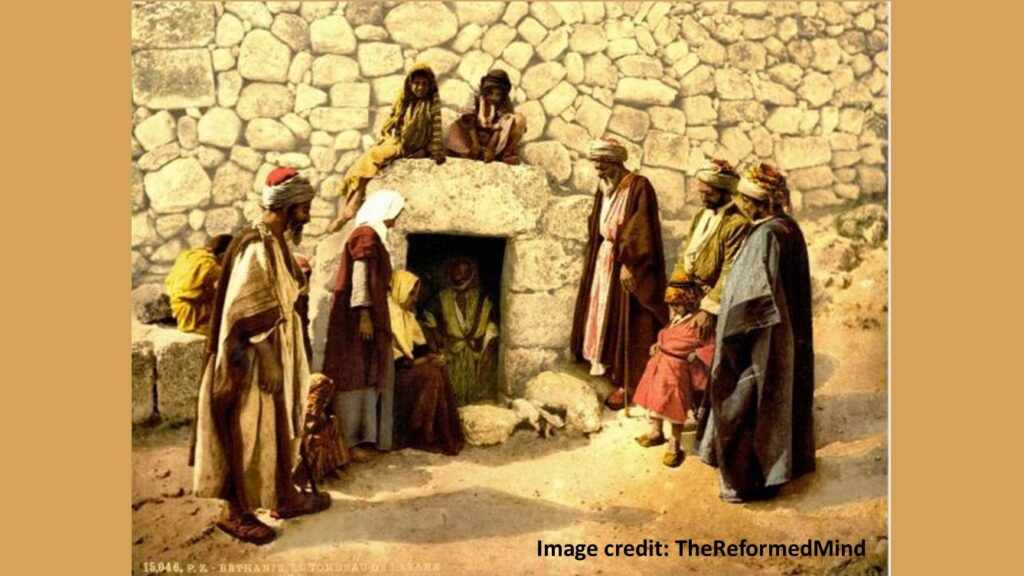
This Sunday, the lectionary invites us to ponder John 11:1-45. The English Standard Version supplies the headings “The Death of Lazarus,” “I Am the Resurrection and the Life,” “Jesus Weeps,” “Jesus Raises Lazarus,” and “The Plot to Kill Jesus.”
In John’s Gospel, the raising of Lazarus is the seventh and last of the signs through which Jesus revealed who he was,[1] prior to being crucified in accordance with God’s plan.
There are many characters: Jesus and the 12 apostles, Apostle Thomas mentioned by name, Lazarus and his sisters Mary and Martha, and “the Jews,” whom came to comfort Mary and Martha, not to antagonize Jesus.
Jesus knew Lazarus had died. He delayed visiting Mary and Martha who were in Judea. Judea, where people had just recently tried to stone him to death for claiming to be God. He didn’t delay only because he feared they would accost him again. He delayed because he wanted time to pass.
The account includes conversations between Jesus and the disciples; Jesus and Martha; and Jesus and Mary. John makes a point of telling us that at the grave, Jesus wept in an agitated, angry way.[2]
This is not the only account of Jesus raising up a dead person. The synoptists[3] tell us of Jesus raising up the son of a widow, and the daughter of a synagogue ruler.[4] But today’s account is unique.
It’s unique because as I’ve already said, it’s a sign, and is the one John has chosen to present as the last sign Jesus did before he was crucified. It’s unique because of the lengthy reporting of it. It’s unique because it’s where Jesus says “I am the Resurrection and the Life.”[5]
It’s unique because of the response of many Jews – because they saw and believed that he was the Messiah, the one whom the Jewish scriptures said would come.
It’s unique because it also says that those who were the guardians of the scripture and the system it created didn’t see and believe. Instead, they saw Jesus as a threat to their authority and decided to kill him.
Why did Jesus raise Lazarus from the dead? I believe Jesus used his friend Lazarus as a prop to show that there’s life after death, and that the life, the eternal life, comes through the action of Jesus. His resurrection shows that there’s a life which death cannot reach.
John highlights the difference between the sisters, Martha and Mary.
Martha went out to meet Jesus. She voiced confidence that Lazarus wouldn’t be dead if Jesus had been present. She misunderstood Jesus’ words “Your brother will rise again.” She thought Jesus meant a future mass resurrection. When he corrected her, she confessed her faith in him. She said,
“Yes, Lord; I believe that you are the Christ, the Son of God, who is coming into the world.”
Martha’s sister, Mary, didn’t go to Jesus till he sent for her. When she saw him, she fell at his feet. Then, she expressed her sadness that he had not been there earlier, for if he had been, her brother would still be alive. She wept more than she spoke.
Mary was grief stricken. Her fellow-Jews, who had come to console her, were also grief-stricken. Jesus was deeply moved. He asked, “where have you laid Lazarus.” They answered, “Lord, come and see.”
Why did they refer to Jesus as Lord? It seems many of them regarded him as someone worthy of honour. Some of them said, “Could not he who opened the eyes of the blind man also have kept this man from dying?” No one thought to ask Jesus to raise Lazarus from the dead.
But Jesus knew why Lazarus had died at that time. Jesus knew he had to let many days pass before he arrived at the scene. Jesus knew Lazarus’ sisters’ and friends had to be certain he had stopped breathing and was wrapped in ingredients which would accelerate the rotting of his body.
Jesus knew Lazarus’ death was like the blindness of the man whose eyesight he had restored. Both these men’s conditions were designed to display God’s glory. To display God’s power. To reveal who Jesus was.
Jesus told them to move away the stone over the entrance of the cave where they had laid Lazarus. They argued. He prevailed. They moved the stone. Jesus prayed. Prayed out loud. To be sure the people would hear. He told his Father, God, that he was certain what would happen next.
He projected his voice into the cave. He shouted, “Lazarus, come out.”
Lazarus came out, walking rigidly. Face, hands, feet, bound in linen cloths. Jesus told the people to “Unbind him and let him go.” They did.
John’s account of what happened in Bethany on that day has been repeated millions of times at Christian funerals: Not to ask God to raise the dead. But to teach the lesson Jesus intended: those who die in Christ will live again.
We must also note the similarities in the death, burial and resurrection of Lazarus with that of Jesus a few days later: cloths, cave, stone.
On that day, Jesus taught us a great lesson; saw his own death and burial; put in motion the men who would kill him.
Should you fear death? Do you fear death? Peace be with you.
Image credit: The Reformed Mind
[1] John explained the first sign, Jesus turning water into wine, with the words “This, the first of his signs, Jesus did at Cana in Galilee, and manifested his glory. And his disciples believed in him” (John 2:11).
[2] According to Moloney, the Greek indicates “deep, shuddering internal emotion.” The reason for Jesus’ anger could be sin, which leads to death; or, everyone’s lack of faith in him, because they wept instead of asking him to raise Lazarus from the dead.
[3] Matthew, Mark, and Luke, whose accounts overlap each other.
[4] See Luke 7:11ff and Mark 4:21-23. See also the answer Jesus sent to John Baptist’s question about whether he was indeed the messiah, in Matthew 11:4 and Luke 7:22.
[5] This is one of many times Jesus says “I AM” in John’s Gospel, indicating he’s God.

To learn more about Rama, click here.