
Humanity’s First Calling
The story of humanity in Genesis begins not with conquest, but with care. In Genesis 2:15, God places the human in the garden “to work it and to keep it.” The Hebrew word avad is key. It can mean “to labor,” but more often it means “to serve” or “to care.” This same word is used for Israel’s worship of God. From the start, our calling is service. We are stewards, asked to protect and nurture the world God made.
This changes how we read Genesis 1:26–28. Words like “dominion” and “subdue” must be understood through the lens of Genesis 2. Authority is not given for domination, but for care. Dominion is a gardener’s rule, guiding creation toward growth. To “subdue” is not to crush, but to cultivate. It is about helping life thrive.
This gardener-like rule flows from who we represent. Our authority is not our own; it comes from carrying God’s identity into the world.
Bearing God’s Name
Carmen Joy Imes explains that Israel’s role was to carry God’s identity into the world. If we are made in God’s image, then our dominion is representative. We act on God’s behalf, not as rulers on our own. To “serve and keep” is our job description. Damage to creation, then, is more than damage—it misrepresents God’s character as a caring Creator.
If misrepresenting God’s character is the danger, then living in ways that reflect His care is the remedy. Robin Wall Kimmerer helps us see this through her vision of creation as a gift economy.
An Economy of Gifts
Robin Wall Kimmerer describes nature as a gift economy. The serviceberry tree, for example, gives fruit freely. Humans are not just takers; we are partners. Our tending and protecting are gifts back to creation. Mosses, she writes, “ask for so little and offer so much.” They teach humility and patience. This is what shamar—to keep—looks like: active, loving care.
This picture of give-and-take challenges the myth that humans stand apart from nature. It prepares us to hear Christine Webb’s warning against human exceptionalism.
Rejecting Human Exceptionalism
Christine Webb warns against the myth that humans are separate from nature. Genesis shows we are formed from the same dust as other creatures. We are placed in the garden, not above it. Our calling is to care for our kin in creation, not exploit them.
Seeing ourselves as kin with creation brings us back to the heart of Genesis 2:15. It reminds us that our calling is service, not domination.
Living as Servant-Gardeners
To bear God’s name rightly means living in a gift economy, where our work is a grateful response to God’s generosity. Stewardship is not about control but about kinship—guiding creation toward harmony, much like a gardener tending life with care.
Sin twists this calling. It turns service into misuse and care into control. But Christ, the perfect servant, heals what was broken. In Him, all things are reconciled, and we are invited to join in that healing work. Our task is to show His love by serving and keeping the world as part of God’s grace.
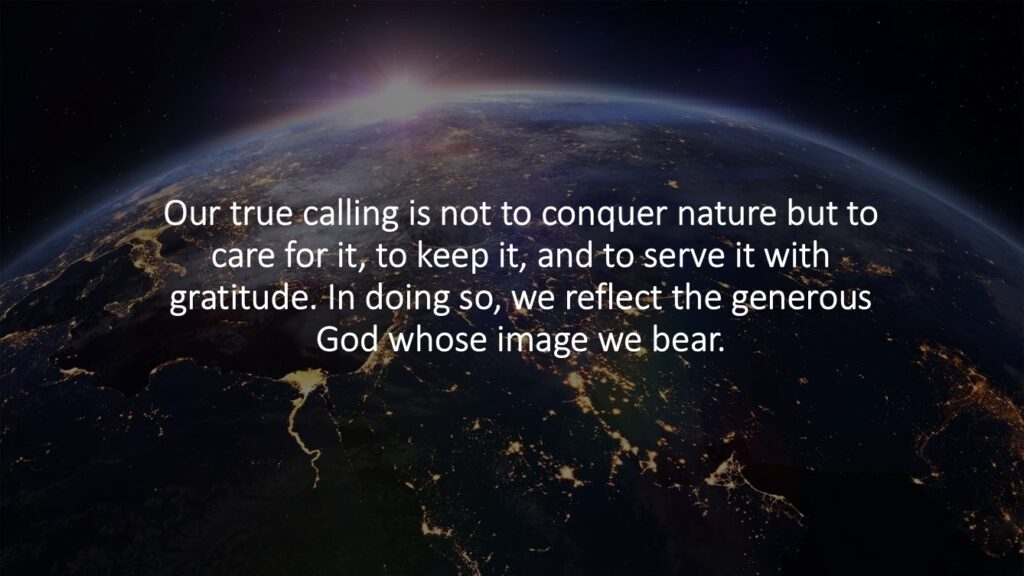
The cry of the land today is a call back to Genesis 2:15. It asks us to lay down arrogance and take up the humble tools of the servant-gardener. Our true calling is not to conquer nature but to care for it, to keep it, and to serve it with gratitude. In doing so, we reflect the generous God whose image we bear.
Let us begin where we are. Tend the soil beneath our feet, honor the gifts around us, and practice the humble stewardship that Genesis envisions. In small acts of care, we join God’s larger work of healing, becoming servants and keepers of a world that longs to flourish.
Works Referenced:
- Imes, Carmen Joy. Bearing God’s Name: Why Sinai Still Matters
- Kimmerer, Robin Wall. The Serviceberry: An Economy of Abundance
- Kimmerer, Robin Wall. Gathering Moss: A Natural and Cultural History of Mosses
- Webb, Christine. The Arrogant Ape: The Myth of Human Exceptionalism and Why It Matters

To learn more about Rama, click here.