
This Sunday, the lectionary invites us to ponder John 4:5-42. The English Standard Version supplies the title “Jesus and the Woman of Samaria.”[1]
To understand what John wants us to take away from the passage, it’s important to see where he places the story. He places it right after Jesus’ meeting with Nicodemus, the “Teacher of Israel,” which we pondered last week.
The meeting with Nicodemus was at night, in private. Nicodemus came looking for Jesus. The outcome was limited to a disturbing of Nicodemus’ heart. He was left wondering what to do about Jesus.
The meeting with the unnamed Samaritan woman was in bright daylight, in public.[2] She came to the well on other business, to fetch water. She didn’t know Jesus would be there.
It was no ordinary well. It was a deep well dug by Jacob, a grandson of Abraham, to whom God had promised the land. Jacob, whose name God changed to Israel. Jacob, whose twelve sons formed the tribes of Israel. Jacob, ancestor to both Samaritans and Jews.
Then, the well made the difference between life and death. Today, it’s a mere tourist attraction. In Nablus, in the West Bank.[3]
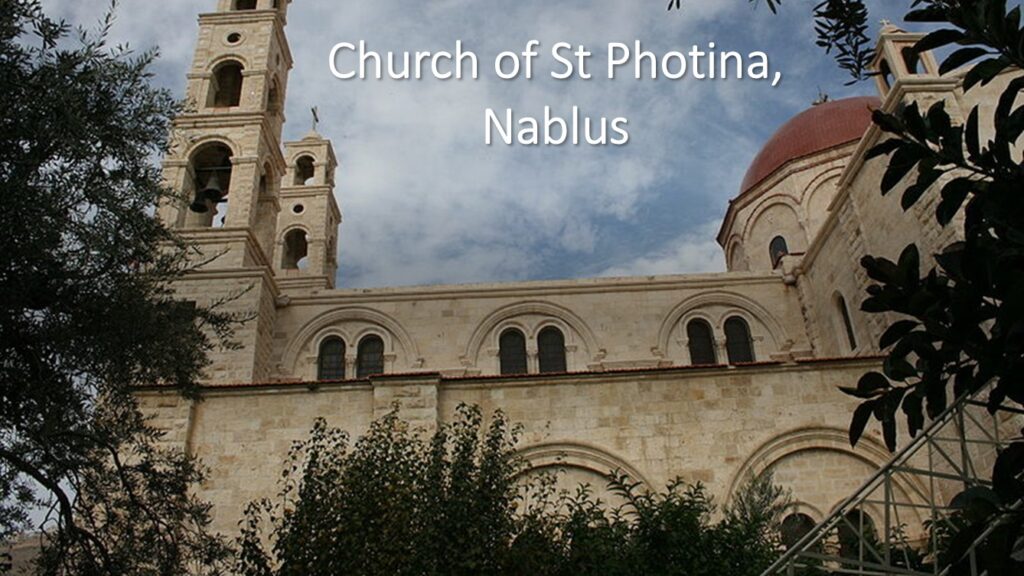
About 350 years after Jesus was crucified, Greek Orthodox Christians built a church around the well. They named the church after Saint Photina, Photina being the supposed name of the Samaritan woman.[4]
At that time, “the Jews” were supposedly faithful, unlike “the Samaritans,” who were shunned by the Jews.
They were supposedly faithful because they worshipped God only in the Jerusalem Temple – unlike the Samaritans who had little regard for the Jerusalem Temple and worshipped instead in a temple on Mount Gerizim.
They were supposedly faithful because they treasured the words of God handed down through what we now call the Bible – the words of God which included predictions of the coming, dying, and raising, of Jesus: though most Jews didn’t see it or admit it.
The Samaritans were unfaithful because they accepted only the first five books of the Bible. Nothing in these books made them expect a saviour who would come and die and be raised up in order to save the world.
But there was one thing the Samaritans did expect. They expected the coming of a great teacher,[5] a prophet, whom they called Taleb. One who would show them how to live in ways pleasing to God.
That’s why the woman began by sparring verbally with the Jew who asked her to let him drink some of the water she had drawn. She mocked him. She said what amounts to “You Jews cross the street when you see us, because you say we’re polluted. But now you want my water to save yourself!”
But Jesus knew his encounter with her was no accident. He used it to reveal who he was. He turned the talk from dead water, still water in a well, water which can be polluted. He turned the talk to living water, water gushing out from the ground, fresh, not polluted.
Then, he raised the matter to another level. He moved from water which sustains dying life to water which gives eternal life. The woman was attracted. But she couldn’t get past her physical need. She asked for the water so that she wouldn’t have to hike to the well so often to draw water.
Jesus then used his divine insight to reveal himself. He told her something he could only have known through super-human means. Something like what John told us earlier that Jesus had told Nathanael:
“Before Philip called you, when you were under the fig tree, I saw you.”[6]
Jesus told her to go call her husband.
She said she had no husband. Jesus answered that she had spoken truthfully. And added that she was living with someone she wasn’t married to. And that she’d had five husbands before.
Jesus’ words reset her. She switched from mocking mode to respecting mode. She now addressed him as “Sir.” She recognized him as a prophet, a spokesperson for God. She asked him about right worship – whether on a mountain in Jerusalem like the Jews, or on mount Gerizim, like the Samaritans.
Jesus again raised the matter to another level. He said right worship wasn’t about where we worship; it’s about time, spirit, and truth:
“But the hour is coming, and is now here, when the true worshippers will worship the Father in spirit and truth, for the Father is seeking such people to worship him. God is spirit, and those who worship him must worship in spirit and truth.”[7]
The woman got it. Unlike Nicodemus, “the Teacher of Israel,” she saw and said immediately that such teaching was what she had been taught to expect from “the Messiah, the Christ,” who was to come. John tells us how Jesus responded:
“Jesus said to her, ‘I who speak to you am he.’”
Can you see the twinkle in John’s eye, the joy in his being, as he recalls what happened next? She left her water jar, rushed back to her village, ran along the streets, shouted out the good news, the gospel.
She became an evangelist. Because a deep thirst within her had been satisfied. John’s heart must’ve danced with delight as he wrote:
“Many Samaritans from that town believed in him because of the woman’s testimony, “He told me all that I ever did.” So, when the Samaritans came to him, they asked him to stay with them, and he stayed there two days. And many more believed because of his word. They said to the woman, ‘It is no longer because of what you said that we believe, for we have heard for ourselves, and we know that this is indeed the Saviour of the world.’”[8]
I can see why they built a church to commemorate her. I can hear the preacher’s words at the dedication service of the church, 1,700 years ago. I hear the preacher reading verses 35-38 from our passage:
“Do you not say, ‘There are yet four months, then comes the harvest’? Look, I tell you, lift up your eyes, and see that the fields are white for harvest. Already the one who reaps is receiving wages and gathering fruit for eternal life, so that sower and reaper may rejoice together. For here the saying holds true, ‘One sows and another reaps.’ I sent you to reap that for which you did not labour. Others have laboured, and you have entered into their labour.”
We don’t convert people. God does. But he expects us to welcome them, house them, train them, and send them out, just like he’s sent us out.
Peace be with you.
[1] Verses 1-45.
[2] The fact that she was a woman, and that she was a Samaritan, is extremely important. But I don’t have the space or time to discuss it.
[3] Today, 99% of the population of Nablus are Palestinian Arab Muslims. But Nablus is governed by the Israeli army. In the language of international law, the West Bank is an “occupied territory.”
[4] You can read about it here: https://www.seetheholyland.net/tag/church-of-st-photina/#:~:text=A%20cruciform%20church%20built%20around,churches%20in%20the%20Holy%20Land.
[5] See Deuteronomy 18:15.
[6] John 1:48.
[7] Verses 23-24.
[8] Verses 39-42.

To learn more about Rama, click here.