
This Sunday, the lectionary invites us to ponder Matthew 4:12-23. The English Standard Version supplies the heading “Jesus Begins His Ministry” to verses 12-17, and the heading “Jesus Calls the First Disciples” to verses 18-22.
Jesus is just out of the desert experience of 40 days of temptation following his baptism by John Baptist. He hears of John’s arrest. He “withdraws into Galilee;” he moves from Nazareth to Capernaum.
Matthew adds that Capernaum was in the land of “Zebulun and Naphtali.” And that the Prophet Isaiah had written, long ago, that the people living there, in “the shadow of death,” would see a great light.
Zebulun and Naphtali are the names of territories God gave to the Israelite tribes of Zebulun and Naphtali. Long before Jesus’ time, these lands had been conquered by the Assyrians. During Jesus’ time, these lands were known as Galilee; of the Gentiles, ruled by the Romans.
Matthew was writing in a politically charged time. He could not name the Romans. Oppressive rulers. Rulers under whom there was great darkness: exploitation, hunger, homelessness, sickness, death.
So much so that the people were longing for a military-political leader to save them. And were, hopefully, naming many of their male children Yeshua, which means “Yahweh saves” and is “Jesus” in Greek.
Jesus entered the land which was his Davidic heritage.[1] He preached what John Baptist had preached before him: “Repent! Change your ways! For the Kingdom of Heaven, the Kingdom of God, is at hand. The king is coming!” Jesus preached knowing that he himself was the king.
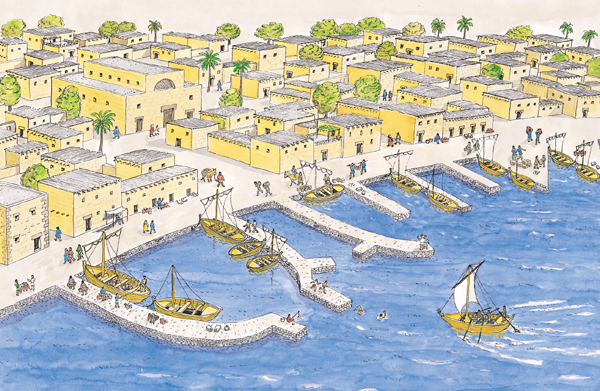
Capernaum was a fishing centre. The fishermen, in order to fish, had to enter into contracts with the Roman authorities. They had to pay for the right to fish and had to deliver set amounts of fish to the authorities.[2]
Matthew tells us that one day, while Simon Peter and Andrew were casting their nets, Jesus called out to them. He said, “Follow me, and I will make you fishers of men.” Matthew writes, “immediately they left their nets, and followed him.” They abandoned their contracts.
Matthew then tells us that as they were leaving, Jesus saw two other brothers, sitting in a boat, with their father, mending their nets. Jesus called them too. Matthew tells us, “Immediately they left the boat and their father and followed him.” They too abandoned their contracts.
Powerful words. “Follow me.” And “immediately.” Did they have any idea what following Jesus meant?
Before I address that question, I must point out that the accounts of how the four disciples in today’s passage first met Jesus are different in the Gospels of Luke and John.
Luke says Jesus called Simon, James, and John, together after they had hauled in a miraculous catch of fish, as directed by Jesus.[3] John says Andrew and another unnamed person asked to follow Jesus and Jesus agreed. Then, Andrew went and called Peter.[4]
The Gospels were written according to the norms of the day, to serve particular agendas.[5] The authors, whom we call Evangelists, didn’t all use the same sources, and wrote for different audiences. It’s probable that Mark wrote mainly for Gentiles, while Matthew wrote mainly for Jews.
The Evangelists didn’t consider important the order in which Jesus called the inner circle of his disciples, whom we call the Twelve. But they did include some information about some of the Twelve.
For example, John tells us Jesus “saw” Nathaniel under a fig tree before Philip brought him over, and three Gospels tell us Matthew had been a tax collector.[6] And that Simon (not Peter) was a member of the Zealot party, who wanted to use violence to overthrow the Romans.[7]
I return now to whether the early disciples knew what following Jesus meant.
When we read their reactions to much of what Jesus said and did, we realize that the best description of them is the one Jesus himself used: They were slow of understanding.[8]
So, why did they drop everything and follow Jesus?
In the first months of my discipleship, a man called Mr Purdie asked me why I chose to follow Jesus. I said I somehow “smelt” that some people were dangerous, harmful, and should not be followed. And that I “smelt” that some people had something I longed for. And they led me to Jesus.
Mr Purdie pointed me to a passage of scripture, 2 Corinthians 2:14,
“But thanks be to God, who in Christ always leads us in triumphal procession, and through us spreads the fragrance of the knowledge of him everywhere.”
The Four, the Twelve, and many more, joined Jesus in proclaiming, “Repent, for the kingdom of God is at hand.” In that time of great oppression, whom do you think their proclamation was directed to?
Peace be with you.
[1] Matthew begins his Gospel with a genealogy, showing Jesus is of the line of King David.
[2] The contracts were awarded to koinonoi, which means cooperatives. Estimates of the amount extracted vary from 25-40 percent of the catch.
[5] Last week, I compared the Gospels to advertisements designed to produce change.
[6] See Matthew 9:9; Mark 2:14; Luke 5:27.
[7] Like the tactics used by the Communist Party of Malaya from 1948-1960.
[8] See for example Matthew 15:16.

To learn more about Rama, click here.