
Traffic. Deadlines. The haze. The constant scroll through social media. Living in the Klang Valley means our eyes are wide open. But are we really seeing? We look at screens. We look at the road. We look at our never-ending to-do lists. Yet like the two disciples walking to Emmaus, we can miss the most important thing right in front of us.
The Road to Emmaus
Two heartbroken followers are walking and talking. A stranger joins them. He explains the Scriptures, and their hearts burn within them. But it’s not until they sit down to eat, and He breaks the bread, that something dramatic happens: “Then their eyes were opened and they recognized him…” (Luke 24:31).
A beautiful moment. But why does Luke choose that exact phrase — “their eyes were opened”?
The phrase “their eyes were opened” in Luke 24 reaches all the way back to the first time those words appear in Scripture — in Genesis 3:7. After Adam and Eve eat the fruit, we read: “Then the eyes of both of them were opened, and they knew…“
Two Meals, Two Openings, Two Worlds
Pause and let that sink in.
In a garden, at the first meal, the first two people eat. Their eyes open — and what do they see? Shame. Nakedness. Fear. They realize that they have fallen. They hide from God. That first dawning of sight leads to separation and blame. It’s the original tragedy. Its effects are all around us — broken relationships, anxiety, injustice, emptiness.
Fast forward to the road to Emmaus, at another meal with two other people, their eyes were also opened. This time, they don’t see shame. They see Jesus — the risen Lord. They finally understand: the suffering they witnessed wasn’t the end. It was the centre of God’s plan to rescue the world. The Scriptures they had heard since childhood — Moses, the prophets, the psalms — were all pointing to this moment. Their eyes now see hope, joy, and new creation.
This is the gospel. It’s the story of the second meal reversing the first. Jesus is the new and better Adam. He hosts a feast where our sight leads not to shame, but to redemption. He took the brokenness of that first meal on Himself at the cross. Now He offers us a place at His table where we can finally see Him clearly.
A Lenten Journey to Open Eyes
This theme of opened eyes takes on special meaning during Lent. The season invites us to walk with Jesus toward the cross. It’s forty days of honest self-examination. We confront our own “Genesis 3” moments — the ways we hide, the shame we carry, the fruit we keep reaching for.
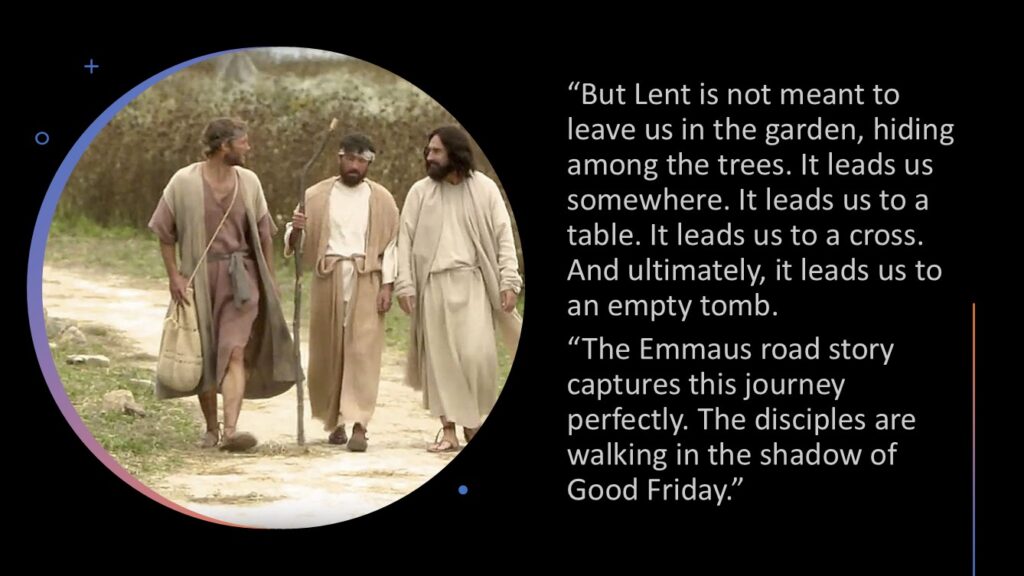
But Lent is not meant to leave us in the garden, hiding among the trees. It leads us somewhere. It leads us to a table. It leads us to a cross. And ultimately, it leads us to an empty tomb.
The Emmaus road story captures this journey perfectly. The disciples are walking in the shadow of Good Friday. Their hopes have crashed. They don’t recognize Jesus because they are still stuck in the sadness of His death. They haven’t yet grasped the resurrection.
Sound familiar? How often do we walk through Lent with our eyes fixed on our own failures, our own sacrifices, our own spiritual performance? We forget that the whole season is meant to open our eyes — not to our shame, but to our Savior.
Lent is the long walk to Emmaus. And at the end of that walk, Jesus is waiting to break bread and open our eyes.
A CNY Connection: Meals With the Potential to see Jesus afresh
This hits home during Chinese New Year. Many of us gather around tables. Yee sang. Steamed fish. Trays of CNY cookies. Reunion dinners. Open houses. Relatives we haven’t seen in months.
What if we approached these meals with the Emmaus story in mind? As you toss the yee sang and exchange greetings, you could silently pray: “Lord, what truth about Yourself are You showing me today?” The conversations, the stories, the laughter, even the awkward silences — these are moments where the risen Lord can meet us. He can open His Word to us. He can make Himself known.
The Meal We Keep Sharing
Every time we gather as a church for Holy Communion, we come to another table. The bread broken. The cup shared. In Genesis, the meal brought shame and hiding. In Emmaus, the meal brought joy and recognition. At His Table, we remember: the work is done. Our eyes are opening to the new creation He has already begun.
We don’t need to force emotional experiences. We just come with expectant hearts. We ask Him to lift the veil again. To help us see His grace afresh. His victory over sin. His invitation to new creation.
The table on Emmaus road. The tables in our homes at CNY. The Communion table in our sanctuary. All point to the same truth: Jesus meets us in meals. He opens His Word. He clears our sight. And He gives us Himself.
What About Us?
So how are our eyes, here in the Klang Valley?
We may feel exhausted. Distracted. Weighed down by city cynicism. We may feel like we’re walking a long road, wondering where God is in the daily grind.
The Emmaus road reminds us: Jesus meets us where we are. On the road. In the ordinary. Even in our disappointment. He walks with us. He opens the Scriptures. And He makes Himself known in a meal.
This Lenten season, as we gather with loved ones for CNY, and as we come to the Lord’s Table as a church, let us ask: Lord, open our eyes.
May the Lord who opened the eyes of two sad disciples open ours too — at every table we gather around this season.
Let us pray
Lord Jesus, like the disciples on the road, our vision grows dull. We get distracted by city noise, festive busyness, and our own disappointments. Walk with us through this Lenten journey. Open the Scriptures to us. Meet us at every table — crowded with family or gathered as Your church — and clear our sight to see You: not as a stranger, but as our risen Lord and Savior. Amen.
Note:
- This reflection was inspired by an episode of “The Biblical Mind” podcast with Matt Swale and Dru Johnson. Available here: https://podcasts.apple.com/my/podcast/the-biblical-mind/id1468537756?i=1000746192369
- For those interested, Dane Ortlund’s article in the Journal of the Evangelical Theological Society (2010) explores the connection in more depth. Available here: https://etsjets.org/wp-content/uploads/2011/01/files_JETS-PDFs_53_53-4_JETS_53-4_717-728_Ortlund.pdf
- Summary/discussion of Ortlund’s work are available here:
- https://www.thegospelcoalition.org/blogs/justin-taylor/and-their-eyes-were-opened-and-they-knew-genesis-37-and-luke-2431/
- Summary/discussion of Ortlund’s work are available here:

Read more about Davin here!
Pingback: The Emmaus Road: From Downcast Eyes to Burning Hearts – Bangsar Lutheran Church